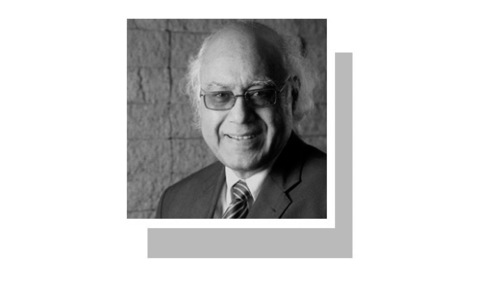
KARACHI: Former top civil servant and social activist Tasneem Ahmad Siddiqui who passed away from a sudden cardiac arrest at the age of 82 early on Saturday morning in Karachi, was most celebrated for his conceptualisation of the project known as Khuda Ki Basti in Hyderabad and the reinvigoration of the Sindh Katchi Abadis Authority.
Both of his most significant professional achievements were connected to his abiding interest in providing affordable housing to the urban poor. The Khuda Ki Basti-Incremental Development Scheme (aka ‘City of God’) that he designed won the Aga Khan Award for Architecture in 1995 while Siddiqui’s services as a government servant were recognised by the prestigious Ramon Magsaysay Award of the Philippines government and a Sitara-i-Imtiaz in 1999.
Born in 1939 in Meerut, India, Siddiqui migrated to Pakistan in 1947 and received his early education in Sukkur. He later completed a masters in political science and English literature at the University of Sindh in Hyderabad before joining the civil service in 1965. In 1983, he also obtained a masters in public administration at the Harvard’s Kennedy School of Government.
It was as a young civil servant that Siddiqui first got to know Dr Akhtar Hameed Khan and see his development work in Comilla, East Pakistan, which would have a profound effect on him. After Dr Khan set up the Orangi Pilot Project (OPP) in Karachi in the 1980s, Siddiqui would spend a lot of time with him, absorbing his ideas about the uplift of the poor.
He utilised that experience in 1987 as director general of the Hyderabad Development Authority in designing the concept of the Khuda Ki Basti project, which was based on providing the poor a piece of land at affordable rates and letting them build their shelters incrementally, using their own resources and labour. His design sought to use insights from informal land developers, often decried as a ‘mafia’, as well as control land speculation. In 1992, he also set up an NGO, Saiban, to spread the model to cities like Karachi, Gharo and Lahore.
On the insistence of Dr Khan, Siddiqui took over the moribund Sindh Katchi Abadis Authority (SKAA) in 1991 and completely revamped it, making it easier for so-called ‘illegal settlements’ in cities to be regularised through leases, making SKAA self-financing, reducing costs for infrastructure, and increasing outreach to communities for services such as health, credit and education.
“Land is the currency of corruption in Pakistan,” says journalist and longtime friend Ghazi Salahuddin, “but that Tasneem used it to make housing available to the poor was his remarkable achievement.”
Urban planner and architect Arif Hasan, who worked closely with Siddiqui, says: “Tasneem Sahib was an awaam-dost [people-friendly] bureaucrat. He didn’t want the trappings of luxury and protocol that most bureaucrats seem to cherish. He always started something new wherever he went. His most singular contribution was trying to turn the OPP-inspired katchi abadis model into a government model of how to work with poor communities.”
“It didn’t spread because of bureaucratic resistance and, in the last few years, he felt the system had collapsed, but he continued to believe that it could be turned around if the bureaucracy wanted,” adds Hasan.
Another longtime friend, former PTV newsman and social activist Jaffer Bilgrami, also remembers Siddiqui as a “pro-people bureaucrat, a dervish with sterling qualities. He was very different from the rest of the bureaucracy,” says Bilgrami.
Siddiqui retired from the civil service in 2005 after having served as the top bureaucrat for a number of ministries as well as chief secretary of Sindh, but continued his work with Saiban as well as penning a number of books and articles on governance and social change.
“He never wanted cushy postings,” recalls Salahuddin. “In fact, he used to say, ‘Nobody wants to come to the Katchi Abadis Authority and I don’t want to leave!’ Where do you find these kinds of people anymore? He was the kind of civil servant that Pakistan needed and almost never had.”
Siddiqui leaves behind his wife of 48 years Kishwar Sultana, two sons and a daughter. His funeral prayers will be offered on Sunday (today) at Tariq Masjid in the Naval Housing Society.
Published in Dawn, January 30th, 2022