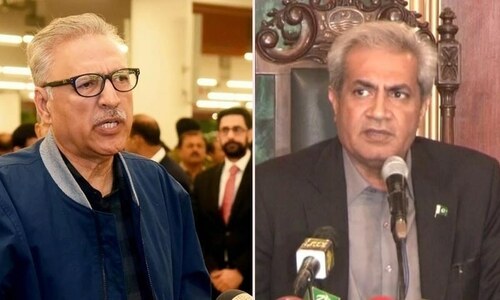
AMID the political battle that the Punjab governor is embroiled in with the prime minister over the former’s removal from office fuelled by his reluctance to administer oath the incumbent chief minister of the province, legal experts believe Governor Omar Sarfraz Cheema is wrongly interpreting the constitutional provisions regarding the powers vested in the prime minister to appoint and remove a governor.
Sources in Governor House shared with Dawn the legal position taken by Mr Cheema on a summary sent by Prime Minister Shehbaz Sharif to President Dr Arif Alvi for the governor’s removal. They said the governor had been advised by some lawyers that he was supposed to remain in the office until the president pleases.
‘PM logical person to advise removal’
Advocate Usama Khawar disagrees with the governor’s interpretations for multiple reasons. He says the fact that a governor is appointed on the advice of the PM under Article 101, and Article 48(1) of the Constitution specifically stipulates that the president shall act on the advice of the PM in the exercise of his functions. He maintains that making an appointment is a function not a power.
Considering the recognised principles of interpretation and the General Clauses Act, he says, the appointing authority has the power to remove as well, and since the governor is appointed on the advice of the PM, he is the natural/logical person to advise the removal as well.
Lawyers say president has no absolute discretion in parliamentary democracy, always acts on PM’s advice
‘President only figurehead’
Also disputing the governor’s interpretation, Advocate Umar Gillani says an expansive interpretation of the presidential powers being adopted by Punjab Governor Cheema relies upon a disjointed reading of Article 48(2) of the Constitution. A holistic and purposive reading of the Constitution shows that the main principle governing presidential powers is contained in Article 48(1) — the president is only a figurehead and is bound by the advice of the federal government.
He argues that this is the case both when appointing provincial governors as well as when removing them. He explains that the notion that the president doesn’t have to act in accordance with the federal government’s advice when removing governors because Article 101(3) uses the term “hold office during the pleasure of the president” is misconceived.
Similar language, Advocate Gillani says, is found in articles 100 and 140 related to the attorney generals and advocate generals, respectively. He maintains that it is well-settled that it is the governments, and not presidents, who can appoint or remove these law officers.
Misinterpreting the word ‘pleasure’
Advocate Khurram Chughtai also maintains the president has no absolute discretion in a parliamentary democracy. He argues that the president always acts on the advice of the PM.
He believes the governor or his legal peers are misinterpreting the word “pleasure” mentioned in the Constitution. He points out that Article 91 says the PM will serve “during the pleasure of the president”. “Does this mean the president can remove the prime minister anytime?” he questions.
He asserts that the “pleasure of the president” means the pleasure of the federal government or the PM because articles 48 and 91 clearly show that the president will act only on the advice of the prime minister. These are ceremonial provisions of the Constitution without any absolute discretion to the president, he adds.
‘Removal only when president desires’
However, Mubeenuddin Qazi, an advocate of the Supreme Court, supports the governor’s stance, saying there was a difference between appointment and removal of the official. He argues that the appointment is made by the president on the advice of the PM, and once appointed the governor holds office until the president desires his removal.
He states that the constitutional provisions for appointment of a governor would only be invoked once the office of the governor falls vacant, and not while an incumbent is still holding office. After a governor’s appointment, the premier has no powers to remove him and his advice for the removal of a governor is not binding on the president.
The lawyer further argues that clause (2) of Article 48 of the Constitution specifically provides that clause (1) requiring the president to act on the advice of the PM and the cabinet, is not applicable in the matters where the president has the power to act in his discretion as provided in the Constitution. He insists that there is a difference between the powers and the functions of the president, and a governor’s appointment is a power and not a function.
Published in Dawn, May 6th, 2022