THE ISPR has of late asserted ad nauseam that the military has “nothing to do with politics”, implying one may assume that institutional boundaries will (henceforth) not be trespassed. Indeed, domestic political developments in the past few months have pivoted around this claim. But old habits die hard. And the urge to ‘shepherd’ matters that clearly belong in the civilian domain has once again manifested itself.
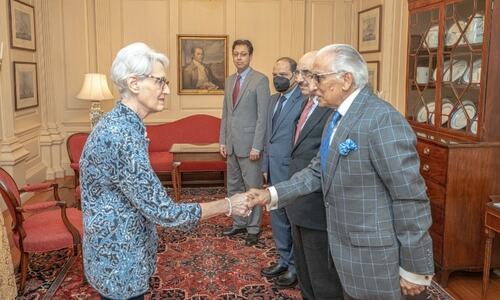
According to a dispatch from New York by Nikkei Asia, Gen Qamar Bajwa held a phone conversation earlier this week with the US Deputy Secretary of State Wendy Sherman to request Washington’s assistance in securing speedy disbursement of IMF funds. The report, based on sources in the US and Pakistan, said that “dwindling foreign reserves” have triggered “a scramble in Islamabad to avoid a default”.
Certainly, Pakistan’s economic situation is grim — grim enough to make individuals, or institutions, believe it warrants an all-hands-on-deck approach, which was likely the impetus behind Gen Bajwa’s move to have the IMF bailout expedited.
Nevertheless, it is for Islamabad, and not Rawalpindi, to handle the delay in disbursement of the funds.
That is what the coalition government attempted to do when Tariq Fatemi, one of Prime Minister Shehbaz Sharif’s advisers, met Ms Sherman earlier this month in Washington to convey a message similar to that of the army chief.
Editorial: Army’s step back
The blurring of institutional boundaries over several years, not to mention outright military takeovers, has led to a regrettable situation in which civilian governments are perceived as perpetual underlings of the security establishment, unable to take independent decisions without the latter’s endorsement. Admittedly, politicians themselves have at times ceded space to unelected forces for expedient reasons, thereby intensifying the civ-mil imbalance. More often, however, the military has used its coercive power and a sense of entitlement that comes from having been in the driving seat for much of Pakistan’s history, to muscle its way into areas purely in the civilian domain.
In some ways, Gen Bajwa has waded even further into matters beyond the realm of security than did his predecessors. Allowing himself to be included in the National Development Council set up by the PTI government in 2019 to devise policies for accelerating economic growth was unwise; it placed the general and his institution in too close a proximity with the faltering economy and exposed them to criticism.
Imran Khan has criticised the army chief for contacting Ms Sherman. However, as prime minister, Mr Khan appeared happy to let Gen Bajwa ‘mentor’ him on trips to Saudi Arabia and China to ask for financial assistance and for streamlining the CPEC projects, respectively.
The army chief’s recent foray into economic diplomacy may have been driven by concern but it nonetheless underscores his institution’s outsize footprint in all things Pakistan. What does it tell the international community about who is the sovereign power in the country?
Published in Dawn, August 1st, 2022