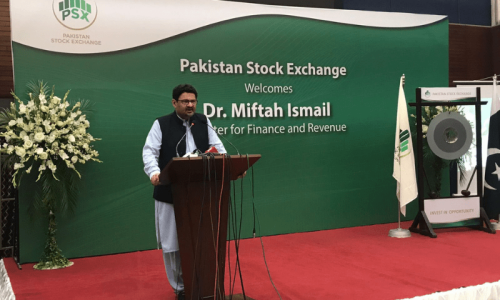
EVER SINCE he was given the toughest possible task of removing Pakistan from the path of economic collapse, Finance Minister Miftah Ismail has had to walk a tightrope.
Nearly four months later, he can take credit for staving off the danger of default — at least for now — by avoiding the potholes. In return, though, he has had to accept some very harsh conditions laid down by the IMF to obtain bailout dollars. It has meant increasing the tax burden on salaried people and corporates, drastically raising fuel and power rates and restricting imports in order to bring down the current account deficit.
On Friday, Mr Ismail told wealthy investors, bankers and stockbrokers at a PSX function that Pakistan was now headed in the right direction. But is that really the case?
All the policies and tough decisions implemented by the PML-N-led ruling coalition have so far translated to firefighting in order to revive the IMF programme. The government has not sought to permanently tackle the inherent structural imbalances in the economy that lead to the regular boom and bust cycles which keep bringing Pakistan back to the IMF’s door for a bailout.
Articulating his government’s economic strategy, the minister said his priority was to control the fiscal deficit and narrow the current account deficit by limiting burgeoning imports, at least over the next three to four months, and use this period to increase exports.
“We are on the right track and if we control our imports for three months, we can boost our exports through various means,” Mr Ismail reportedly said at the PSX ceremony.
Read: Import dependency
It is true the strategy has started to produce some ‘positive’ results. The July trade gap is down by nearly 48pc month-on-month due to the 38pc decrease in imports. This is in spite of a 24pc plunge in exports.
The trend is likely to hold during this month — and probably over the next couple of months as well — as the build-up of record oil stocks in June will help significantly in bringing down the energy import bill. Also the fears of recession in developed economies are expected to make global oil cheaper going forward. We can then assume that the current account deficit will shrink over the next few months.
While few would disagree about the efficacy of this strategy for the moment, this is not a sustainable solution to the long-standing structural issues facing the economy.
We will not be out of the woods unless we decide to deal with such structural imbalances as very low agricultural and industrial productivity, an unsustainable tax-to-GDP ratio of just above 9pc, poor documentation of the economy, wasteful public sector expenditure, inefficient state-owned businesses and the exclusion of the vast majority of people from the financial system. Sadly, the government has so far shown no signs of addressing these issues.
Published in Dawn, August 6th, 2022