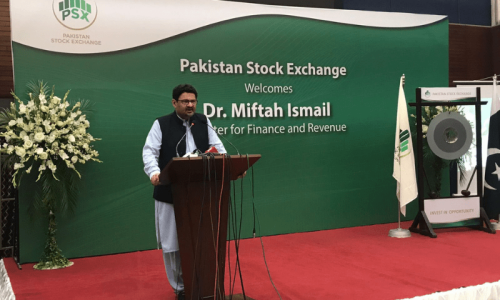
Finance Minister Miftah Ismail clarified on Saturday that neither the State Bank of Pakistan nor he had “directly intervened” to bring the dollar’s value down, stating that it was influenced by market factors.
Addressing the Karachi Chamber of Commerce and Industry, he said he disagreed with a KCCI member’s stance that he had something to do with the dollar’s declining value. “Neither the State Bank nor I have directly intervened (to bring the dollar down). It falls on supply-demand,” he stated.
The rupee has been on an upward trend against the dollar in the interbank market, gaining Rs16.26 since July 29.
During his address, Ismail also doubled down on the government’s decision to curtail imports for the next three months, stating that it was a necessity.
“We have imposed a ban on CBU cars, mobile phones and home appliances which we will not remove till September. The restrictions on [import of items with H S Codes starting with] 84 and 85 are with reason,” he said. However, the minister said authorities were working on identifying items used by exporters for manufacturing products and their import would not be stopped.
He assured that the government had not stopped payments on any letters of credit that had been opened in the past and would not do so in the future as well.
The minister noted that the country’s imports last year stood at $80 billion while its exports were a mere $31bn. The country’s current account deficit was $17.5bn while the trade deficit, after subtracting the remittances, stood at $18bn, he said.
“If you create such a wide deficit, there will be pressure on your rupee. Today, Bangladesh has increased the price of petrol to 308 (per litre). They are also under pressure. There is a very challenging environment globally.”
Ismail said Pakistanis should live within their means and in a dignified manner instead of asking for loans. “If we have exports of just $30bn, then we should not import as much. If we do not have products to sell to the world, we should not buy things from it either.”
He said he felt ashamed when he had to meet the ministers of other countries and ask them for loans. “We were giving subsidies worth $500bn on petrol and [had imports worth] $7.5bn and were not exporting at all. We have to go to Saudi Arabia and UAE and ask them to deal with the IMF (International Monetary Fund).
“We were selling petrol cheaper than the UAE. We were selling it cheaper than the country from which we buy refined oil,” he added.
He acknowledged that mistakes would be made and exporters might face problems in importing the material they needed to manufacture products.
Ismail said when he had been advised to remove the fixed tax on traders using less than 300 units of electricity, he had responded, “What can I do then but close the ministry? It amounts to removing tax on 96pc of shopkeepers. Why bother the other 4pc? We should just go home.”
This is not a government versus business thing, the minister said, adding that curtailing imports was a necessity.
“Give me three months. We are all in this together. Let me save this country from problems. Pakistanis will start importing again.”