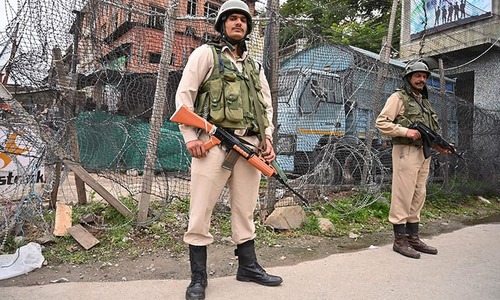
Amnesty expresses grave concern over repression of rights in occupied Kashmir


Amnesty International on Saturday expressed grave concern over the intensified repression of rights in India-occupied Jammu and Kashmir in the last three years.
In a report titled, “‘We are being punished by the law’: Three years since of abrogation of Article 370 in Jammu & Kashmir” released yesterday, the human rights watchdog observed that in recent years, civil society members, journalists, lawyers and human rights defenders in the region had faced relentless interrogations, arbitrary travel bans, revolving door detentions and repressive media policies.
Read more: Fraud and fury in Kashmir
“For three years now, civil society and media in Jammu and Kashmir have been subjected to a vicious crackdown by the Indian government, which is determined to stifle dissent using draconian laws, policies and unlawful practices in their arsenal,” said Aakar Patel, chair of the board of Amnesty International India, in the report.
“By harassing and intimidating critical voices, authorities are targeting all credible, independent sources of information in and about Jammu and Kashmir. There is a silence achieved on all dissent through heavy-handed repression which has spread fear and uncertainty in the region,” he added.
The watchdog said that it had recorded at least 60 instances of crackdowns on journalists and human rights defenders since August 2019.
Read more: India abusing ‘lawless’ detention act in occupied Kashmir
It said that the Indian government had total control over the information coming out of occupied Kashmir after passing restrictive media policies such as the 2020 Revised Media Policy and 2021 Film Policy.
“After an initial 18-month internet shutdown, the Indian authorities still often suspend internet services in various parts of Kashmir often without any prior notice,” the report highlighted, adding that the sudden “forced closure” of the Kashmir Press Club in 2022 by the Indian government was a “big blow to the already disintegrating media pool”.
The human rights body also found that at least six individuals — including journalists, human rights activists and academics in the region — were stopped from travelling abroad despite having requisite travel documents, which it said was a violation of their freedom of movement.
The report stated that at least 27 journalists had been arrested and detained by the Indian authorities since 5 August 2019.
“Several journalists including Fahad Shah, Aasif Sultan and Sajad Gul have been subjected to ‘revolving door’ arrests. In a continuing pattern, they have been arrested under one law, granted bail by the court, and then re-arrested almost immediately under the Unlawful Activities (Prevention) Act (UAPA) — India’s primary anti-terror law in Jammu & Kashmir, keeping them perpetually detained.
“Amnesty International reviewed 1,346 cases available on the website of the High Court of Jammu & Kashmir. It found that by 1 August 2022, the number of habeas corpus petitions have increased by 32 per cent, indicating an increase in unlawful detention in the last three years,” it revealed.
Read more: India batters press freedom and journalists in occupied Kashmir
Amnesty International also reviewed the data published by the Indian National Crime Record Bureau and found that there had been a 12pc increase in the use of UAPA (Unlawful Activities Prevention Act) in Jammu and Kashmir since 2019.
“This emerging trend of using the draconian UAPA in addition to the much-abused Public Safety Act (PSA) is also evidenced by an analysis of information on the High Court’s website,” it noted.
Furthermore, the human rights watchdog said that unlawful killings of the people of occupied Kashmir by armed groups had recently increased. Quoting an analysis of the official data by the Indian government, it said that unlawful killings of civilians by armed groups had increased by 20pc in the past three years.
“There is a lack of accountability for use of force in the region by the police due to the continued enforcement of the Armed Forces (Special Powers) Act (AFSPA) which grants them additional powers and impunity and falls short of international human rights standards.”
Subsequently, Amnesty called on the Indian government to immediately release those arbitrarily detained under administrative detention and other repressive laws and ensure that they were tried promptly and fairly in a regular court.
It also urged the international community to hold India accountable for its grave human rights violations in the region, ensure its cooperation with United Nations Mechanisms and facilitate immediate and independent investigation in the region.