‘It is terrorism’: NA echoes with concern on situation in Swat


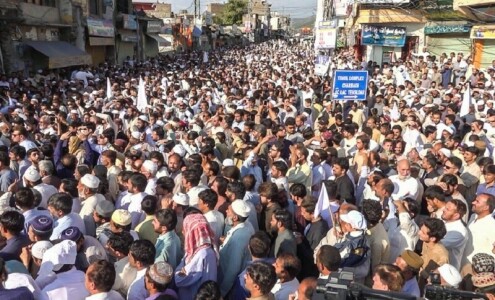
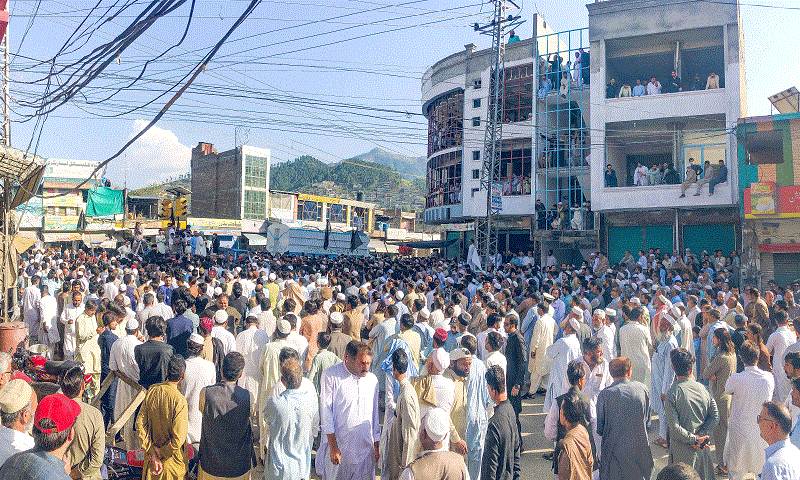
Lawmakers raised concerns over the worsening situation in Swat — where citizens have poured onto streets against growing violence in recent days — during a National Asssembly session on Wednesday.
“What is happening in Pakistan is not an insurgency. It is terrorism,” said Climate Change Minister Sherry Rehman as she compared the situation in the Khyber Pakhtunkhwa district with that in neighbouring Afghanistan prior to the end of a 20-year-long war.
The PPP senator lashed out at violent elements for “hiding their nefarious designs behind religion.
“Sorry, it is only a fight for power. It is not a fight for religion, and have the guts to say it.”
Recalling that the PPP became a “soft target” for denouncing terrorism earlier, she added, “We have not come here to mince words on this [issue]. Neither are we here for terrorism to rear its head again—and rear its head again in Swat.
“This is our country and we have to save it.”
She demanded that “everyone should be taken into confidence on the progress of operations” launched again terrorism and the direction in which they are headed.
“Pakistan has paid a big price [for fighting terrorism] in the past and there have been several successful operations that were acknowledged by the entire world.
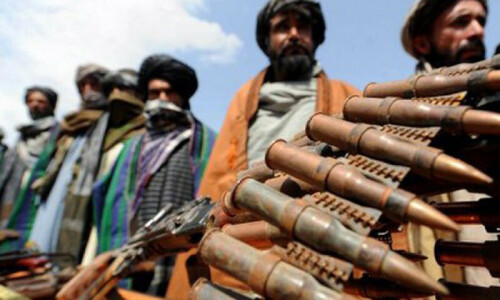
“And now, the TTP (Tehreek-i-Taliban Pakistan) is on the rise. But in what capacity, and as what? Citizens of Pakistan? Have they demilitarised?” she questioned, adding that if such was the case, “show us the evidence”.
Earlier in her address, she said there could no “protracted, result-oriented engagement with terrorism.
“A terrorist is a terrorist and he remains one because he took up weapons. And when he agrees to talk to you, he has pre-conditions.”
She said wherever such elements were engaged in talks, it was after they laid down arms.
The PPP senator recalled multiple incidents of terrorism and said it was beyond her understanding how a compromise could be reached with terrorists.
“We have been in favour of dialogue with anyone who lays down arms and says that he will operate within the ambit of the Constitution of Pakistan,” she said, adding that a joint session of the house was called during the PPP’s tenure to chalk up a strategy against those who continued terrorism.
“Call a joint house again,” she demanded.
Earlier, Defence Minister Khawaja Asif called for sitting together on the situation in Swat, among other issues of grave importance.
He recalled that a similar situation in Swat was seen 11 to 12 years ago when concerns were raised that “those in Swat may not be too far away from Islamabad”.
Today, after a gap of 12 to 13 years, a similar scenario is being witnessed in Swat, he regretted, although adding that presently, it was not of the same “velocity and gravity” as more than a decade ago.
However, he continued, a positive was that the people of Swat had come out and were united against without any discrimination or political differences.
At the same time, he warned that “whatever is happening in Swat and elsewhere, those flames can reach us as well”.
‘Fake encounters in Balochistan’
Earlier in the session, Balochistan National Party-Mengal (BNP-M) chief Sardar Akhtar Mengal recounted various incidents in which, he alleged, innocent people were killed and presented as terrorists.
He particularly referred to the killing of three missing persons allegedly in fake encounter by the Balochistan Counter Terrorism Department in Kharan on Monday.
The BNP-M said the issue had plagued Balochistan for long, warning that most of the youth in Balochistan had reached “a point of no return.
“You may be able to end who you call terrorists through such tactics, but the seeds of hatred that you are sowing cannot be perished by any atomic power of the world.”
He called for constituting a high-level judicial inquiry commission, headed by a sitting Supreme Court judge, to probe the “fake encounters” in Balochistan, particularly referring to three incidents in Ziarat, Mastung and Kharan.
Responding to Mengal, Asif described that issue as “wounds of the state that have been bleeding for years”. And ignoring them or staying in denial would be harmful for any nation, he warned.
He called for measures to address and resolve the issues and acknowledged that the problem had existed for years.
“When will we remove this baggage from our shoulders? It is becoming heavier by the day,” he regretted. “A low-intensity insurrection has been ongoing in Balochistan for many years and a solution to it can be found. We need dialogue,” he added.
The minister also criticised the provincial government on the matter, saying any government — provincial or federal — had no right to rule if it failed to address the grievances of its people.
The issue, he said, could not be “wished away” and the house, too, needed to show some seriousness on the matter.
He called for the “political community” to take the initiative to resolve the issue and prioritise it.
Asif said he believed that security issues should not be dealt with in a “transactional manner” and a permanent solution should be devised.
He said the federation needed to take steps in this regard and the concerns raised by Mengal. “If not today’s, then the future generations will have to face these issues. They are already staring at us.”
It was the institutions’ responsibility to find solutions to the state’s problem, he added.
“A solution to this problem should be devised at a high-level,” Asif concluded.
For her part, Sherry called for constituting a “truth and reconciliation commission” to address the issue in Balochistan.
“We should listen to the province’s leaders … and we may even have to hear some bitter truths,” she added, stressing the need for Parliament to address and find a solution to the issue.