Pak vs Ind: Final over controversies explained in light of ICC rulebook


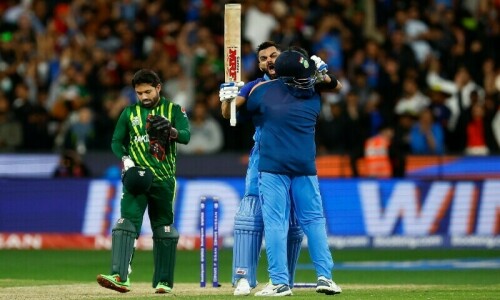
The final over of India’s slim World Cup win over Pakistan on Sunday had two separate controversial moments that had the fans of the losing side up in arms.
In the first instance, which occurred on the third ball of the 20th over, Mohammad Nawaz’s full toss was smacked for a six by Virat Kohli. To add insult to injury, the ball was deemed a waist height no-ball, although TV replays showed that it was a 50-50 call and Kohli was also well outside his crease, although his trailing leg was still on the line.
That was controversy number one and saw Babar Azam and Co approach the umpire for clarity.
To rub salt into the wounds, the resultant free hit — which followed a wide ball — saw Kohli get bowled out but in the same sequence the ball raced towards the third man, allowing the Indian batters to steal three runs.
That was controversy number two as the debate now was: should the ball not have been declared dead after Kohli was bowled out?
What do cricket rules say?
Clause 21.19.2 of the ICC playing conditions for the World Cup states: “For any free hit, the striker can be dismissed only under the circumstances that apply for a No ball, even if the delivery for the free hit is called Wide.”
The no-ball circumstances under which a batter can be out are hitting it the ball twice, obstructing the field or run out.
Since Kohli was bowled out as opposed to run out, or obstruction or hitting the ball twice (the trio covered in the rule book), he was not out. And since he was not out, it was not a dead ball. Thus, technically, the runs were legal.
Regarding the other controversy, clause 41.7.1 of the rule book says:
“Any delivery, which passes or would have passed, without pitching, above waist height of the striker standing upright at the popping crease, is to be deemed to be unfair, whether or not it is likely to inflict physical injury on the striker. If the bowler bowls such a delivery the umpire shall immediately call and signal No ball.”
The rule here appears to be rather vague and can be interpreted either way. If “at the popping crease” incorporates a batsman standing on the line, then Kohli was safe and the umpire made the right call. Besides, if a no ball was tied to the foot of the batsman being “inside” the crease as opposed to just “on” or “at” it, the rule book would have stated so.
However, if a batter being on the line works the same way as it does in stumpings and run outs — where the line famously belongs to the umpire and not the batter — it should not have been a no-ball and there should not have been free hit.
Interestingly, a BBC piece claims that a waist-high full toss is permissible from a slower bowler, as long as it does not go above the batsman’s shoulder. Dawn.com could not find the same on the websites of ICC, the game’s governing body, and MCC, the guardian of the laws of the game. Upon further probe, it was found that the law had been changed in 2017 and the BBC piece was outdated.