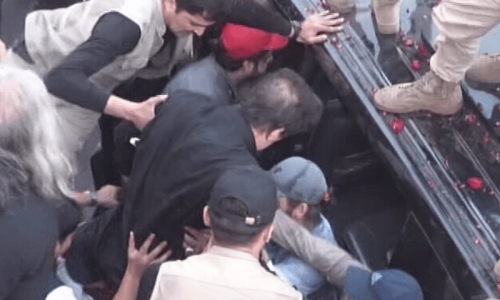
The unfortunate assassination attempt on former prime minister Imran Khan and the reaction that followed from his party leaders pose some pertinent questions as to what this incident means for politics and political discourse and where it could lead the country to.
There seems to be a wide-ranging consensus among the analysts that Dawn spoke to on Thursday that the attack appears to have resulted out of the “hatred injected into body politic” in the last few years, especially since April when Mr Khan was ousted from power, and would only worsen the situation leading to “political tribalism” that further destroys the social fabric of the country.
Shuja Nawaz, distinguished fellow at the South Asia Centre of the Atlantic Council in the US, believes there is no political discourse in Pakistan right now — parties are talking past each other. The incident will complicate the situation further. “However, a full and transparent investigation into the incident is needed (to soothe frayed nerves), first by the Punjab government and then by the Interior Ministry. Forensic evidence of bullets and weapons used is needed. Otherwise, there will likely be further political unrest fuelling economic turmoil.”
Academician and chairperson of Pakistan Seraiki Party, Nukhbah Taj Langah, supports Mr Nawaz’s narrative when she explains: “The hate line drawn in politics is expected to deepen further and politics stoop to new lows. The situation is already complicated because it defies political logic and approach, as the world knows and defines them. What we call political discourse, both nouns sound misnomers, there is hardly any national discourse and one is not certain whether it is even political. Intolerance and hatred define it, which would only increase.”
In the last one month, two journalists have lost their lives – one to bullets in Kenya and the other to Imran Khan’s container – and now the Wazirabad firing at a national leader. “Life is becoming cheap by the day and it may get cheaper if the course is not corrected,” Ms Langah fears.
The PTI only lent credence to the analysts’ fears, when senior leader Fawad Chaudhry, atop the same container where Imran Khan was fired at, declared it “a planned assassination attempt and now party workers should come to the streets throughout the country and ensure revenge”.
Later, PTI Secretary General Asad Umar poured conspiratorial fuel over fire when he, in a video message, said party chief Imran Khan was out of danger and had given a message: “I had the information about an attack on my life and knew the suspects.” He then named three top government and military officials and demanded they be removed immediately to avoid country-wide protests. “The workers should wait for the next protest call,” he added.
Both the PTI leaders took the route that noted journalist Mosharraf Zaidi hints at when he says: “There will invariably be much more escalated anger in the PTI’s statements. This will lead to more rancour and severity in statements from government officials like (interior minister) Rana Sanaullah. This downward spiral will lead to only more divisions and less likelihood of a resolution of the political crisis that has defined the country since March 2022. The only beneficiaries of this crisis are those that champion – openly and implicitly – the idea of a military dictatorship.”
Dr Hassan Askari Rizvi, a well-known educationist and former caretaker chief minister of Punjab, expects more verbal violence, if not physical. He also fears “political tribalism” taking over national discourse and politics on a downhill tumble. “All politicians, without exception, have contributed to this situation and they are least expected to check their streak. Unless politicians check their hate-mongering, the situation will only worsen, worsening much more quickly than what we have seen so far.”
Ikram Sehgal, better known for his defence and security analysis, says though one cannot say how it happened, it may simply be a target opportunity, as many leaders (former prime ministers Benazir Bhutto or Liaquat Ali Khan) before Imran Khan suffered, but things seem more complicated.
“Normally, people do not take automatic weapons to political marches unless they have a specific use in their mind. It may also be a hired assassin. However, whatever it was, the results are sure to take the country only one way: more political chaos, hatred and violence. It may also help Imran Khan politically, as he will be seen risking his life for his cause and may attract more floating voters to him.”
Published in Dawn, November 4th, 2022