WASHINGTON: Foreign Affairs Minister Bilawal Bhutto-Zardari has urged the international community to set up a fund for helping the victims of climate change before the next UN climate change conference, known as COP28, in the United Arab Emirates (UAE) next year.
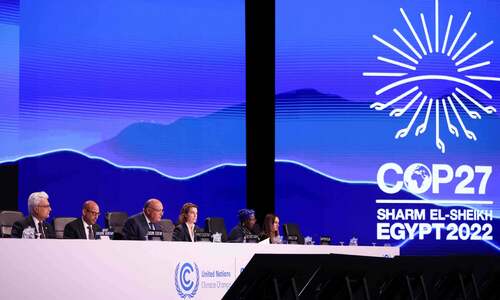
The UAE hosts the next UN-sponsored Conference of the Parties (COP) in November 2023 while COP27 was held in Egypt earlier this month and made a historic decision to establish and operationalise a loss and damage fund to help the victims. Pakistan, which faced unprecedented climate-induced rains and floods this summer, played a key role in concluding this arrangement.
In an interview this weekend to America’s National Public Radio (NPR) network, the foreign minister said the next target was to answer questions like “who’s going to contribute to the fund, how are we going to come up with the international financial mechanisms and how are we going to get it to those who need it the most?”
Britain’s The Guardian newspaper noted that Pakistan brought the resolve to fight back adverse effects of the changing climate to COP27 and “succeeded in keeping developing countries united on loss and damage — despite efforts by some rich countries to divide them”.
Global failure to keep commitments would have devastating consequences, FM warns
Mr Bhutto-Zardari agreed with NPR’s conclusion that the agreement reached in Egypt was “a big victory”, but not for any one individual or one country. “This is a big victory for all of those who’ve suffered from the devastation of the climate change.”
The foreign minister said that many of the affected countries were worried about the international community’s inability in the past to live up to some of its commitments. “And I think that is why it was so important to have the language on the fund,” he added.
When reminded that there’s no consequences if developed countries do not follow through, Mr Bhutto-Zardari warned that failing to keep the commitments would have devastating consequences.
“Not just for the Global North, but also for the Global South, not just for the developed world, but also for the developing world. And being in the position of chair of G-77 plus China, it was all the more important for us (Pakistan), having gone through this tragedy, that this had to get done,” he said.
When the interviewer pointed out that China was the world’s largest emitter, the foreign minister said: “We’ve a commitment to establish a fund and financial arrangements to address loss and damage and a timeline attached to that for us to work out the details.”
“Are you not going to express an opinion of whether or not China should pay into this?” the interviewer asked. “No, no, no, no, no, no, no. It’s not about who should or who should not pay into it. We all have to do our part to combat climate change,” the foreign minister said.
“As far as China is concerned, I recently came back from there, and they’re leading the way as far as reforestation, green energy, etc. But we all have to work together to collectively survive and combat these challenges without … finger-wagging with one side or the other, that you’re doing too much, you’re not doing enough.”
Mr Bhutto-Zardari agreed with the observation that the proposed fund would be “big enough that will cover every country” but countries facing adverse effects of the changing climate need to be helped first.
“Pakistan was first damaged by historic heat waves, forest fires and a massive drought and then followed by this flooding,” he said. “So, a fund available can contribute in the way it will.”
The foreign minister also suggested making rooms for the victims to go to other financial institutions to seek help.
“If I had the space to be able to go to the World Bank, to the IMF, to maybe a climate bank, to other institutions where I would take my own loans at reasonable rates (I would go),” he said.
When reminded that negotiators at COP27 could not agree to phase out fossil fuels, the foreign minister said: “The picture that the climate scientists are painting is extremely devastating. And for us, that picture became reality for us. This is something that has an urgency for now. I wish that there was a technical option where we could all agree that we’re going to turn off our fossil fuel addiction tomorrow.”
Noting that it was not possible to do so, he said: “I think it’s better that we achieved a practical consensus about something that we can do and can achieve, rather than agreeing to something that we would be unable to achieve as of now.”
Published in Dawn, November 29th, 2022