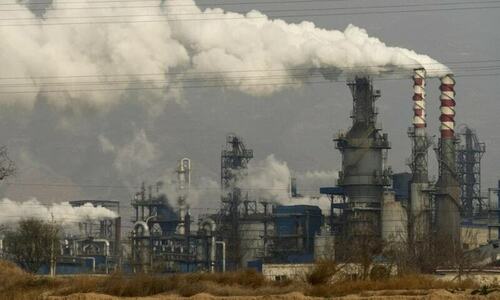
ISLAMABAD: Although Pakistan is a minor contributor to climate change, livestock produces a large share of the country’s Green House Gases (GHG) emissions, reveals a World Bank study.
It states that total national emissions represent 0.7 per cent of global emissions, but livestock alone generates 36pc of this amount. This calls for adequate measures to reduce livestock emissions through better feeding and manure management, emphasised the latest study titled, “Sindh’s Livestock: Getting to know an important but neglected sector”.
It is estimated that the country’s livestock sub-sector contributes 11.7pc to GDP, and as much as 56-60.6pc to the overall agriculture GDP. The contribution of livestock to GDP and agricultural GDP in Sindh specifically is not known but is assumed to be slightly lower than at the national level. Livestock is also a source of foreign exchange earnings, with 3.1pc of exports and being the fifth largest export.
Sindh benefits from comparative advantages for its livestock sub-sector, including a favorable climate, good soils, and the availability of water for irrigation, but with a high level of natural risks and impacts due to climate change. Forty-one per cent of the province is irrigated, and thus suitable for both agriculture and livestock activities, while the non-irrigated areas are only suitable for pastoral livestock activities.
Two major types of climate-related risks affect agriculture and livestock in Sindh: floods and droughts. Both are exacerbated by climate change effects, and their frequency and severity keep increasing. Floods affect mostly the irrigated areas, and droughts mostly the pastoral areas.
In Sindh, an estimated 1.86 million households are involved in rearing livestock for their livelihood. Livestock provides cash liquidity (milk and live animals represent 11pc and 10pc of household incomes, respectively) and contributes to nutrition (seven to eight litres of milk consumed per household per day).
However, the main motivation for a smallholder rural household to keep livestock is its role as an asset-building source and a safety net. Animals are a flexible and disposable asset that can easily be sold in case of climatic shock, food shortage, social event or health problem. For rural households that have little access to credit or insurance, livestock plays this crucial role of shock attenuation.
According to the study, the policy framework for the livestock sub-sector is fragmented and would require to be strengthened. There are no specific policies for livestock, neither at the national nor at the provincial level, and livestock policy options are overshadowed by wider agricultural considerations.
Cattle colonies are a unique feature of Pakistan’s livestock sub-sector and play an essential role in supplying milk to urban centers, but have a very high environmental impact. There are around 1.4m heads of cattle in Sindh’s cattle colonies. Landhi colony in Karachi is the largest, with around 350,000 animals. All the feed is ferried from rural areas.
Cattle colonies are the prime source of milk and meat for over 15m residents of Karachi. This milk is marketed within two to three hours, without a cold chain. The main negative externality is related to effluents management: manure and urine pollute surface water bodies and underground water, with negative consequences both for public health and the environment.
The study says animal diseases affect productivity and increase risks, and because of the limited outreach of veterinary services, and an inadequate control of diseases, several major animal diseases are endemic and sometimes uncontrolled, which affects productivity and creates a public health threat.
Published in Dawn, December 12th, 2022