Death toll from Peshawar mosque bombing rises to 101 as police say ‘major arrests’ made


The death toll from Monday’s suicide attack on a mosque in Peshawar’s Police Lines area rose to 101 on Wednesday as the police claimed major arrests have been made in connection with the bombing.
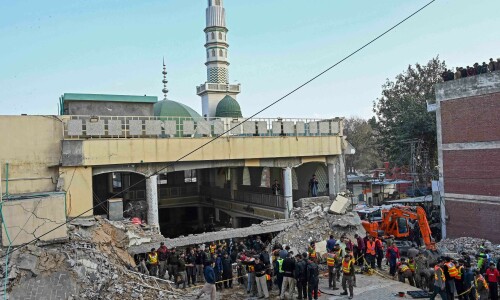
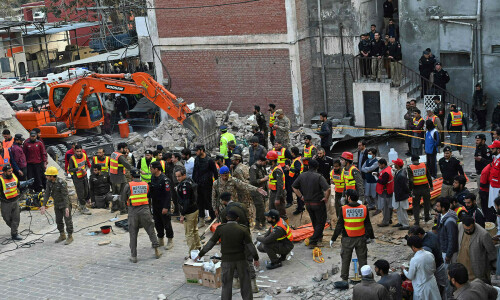
On Jan 30, a powerful explosion ripped through a mosque in Peshawar’s Red Zone area where between 300 and 400 people — mostly police officers — had gathered for prayers. The suicide blast blew away the wall of the prayer hall and an inner roof.
The outlawed Tehreek-i-Taliban Pakistan (TTP) had initially claimed responsibility for the attack. It later distanced itself from it but sources earlier indicated that it might have been the handiwork of some local faction of the outlawed group.
In a statement issued today, the Khyber Pakhtunkhwa Health Department said that the death toll in the attack has increased to 101 after another injured person succumbed to his wounds.
It stated that 59 injured people are receiving treatment at hospitals across the province, of which eight are in critical condition.
Meanwhile, Lady Reading Hospital spokesperson Mohammad Asim told Dawn.com today that 101 bodies were brought to the medical facility.
“At this moment, 49 people injured in the blast are being treated at the hospital. Seven of them have been admitted in the ICU,” he said, adding that a number of injured persons had been discharged as well.
Police say ‘major arrests’ made
Separately, Peshawar police chief Ijaz Khan told Reuters on Wednesday that major arrests have been made in connection with the bombing.
He said police are investigating how the suicide bomber entered the highly-secured police area, and could not rule out internal assistance to carry out the attack.
A day earlier, the police had constituted two joint investigation teams (JITs) to probe the attack. KP police chief Moazzam Jah Ansari told journalists on Tuesday that the security lapse which resulted in this attack was being investigated by the city police chief, whereas a JIT, also including intelligence officials, would seek out abettors.
He said that around 10 to 12 kilogrammes of explosives were used in the attack that caused the roof of the mosque to cave in. These explosives were parcelled into the compound in small portions to avoid detection by security personnel deployed at the entrance of the facility.
IG Ansari also said that security checks were limited to the main gate since there was no central command at Police Lines. Speaking about investigations, he said people should not expect the result within 24 hours since it “is a huge inquiry” and would take a lot of time to pore over footage from CCTV cameras covering the past month.
‘Where is the state?’
Commenting on the bombing during a Supreme Court hearing today, Justice Qazi Faez Isa said: “For how long will we be scared of terrorists?”
“It is being said that terrorists should be given this and that … sometimes it is said that negotiations should be done with terrorists … where is the state in all this,” he asked.
The judge questioned why negotiations were being held with terrorists, adding that “today they have killed two people, tomorrow they will kill five”.
Justice Isa also said that a person could not be declared a “good Muslim” merely on the basis of their “long beards”.
“What kind of a society are we living in? A judge of ours was killed but no one cares,” he added, referring to the recent killing former Supreme Court Bar Association president Latif Afridi in Peshawar.
‘Back on edge’
Meanwhile, residents of Peshawar said on Wednesday that the recent rise in terrorism has put the city back on edge.
“The main fear is a second attack, another blast … a suicide bomber may blow himself in a market,” 55-year-old Naeemullah Jan, a building contractor in the city, told AFP.
Another resident Faisal Khan said that life in the city had become difficult.
“Police are stopping us at every checkpoint,” the 39-year-old salesman said, adding that he was now avoiding going to the mosque and praying at home.
Addition input from Haseeb Bhatti