A SPIKE in terrorist attacks in Pakistan has once again forced the United States and its old — but not always close — ally to consider reviving their coordination against terrorism.
“There are groups in Afghanistan that pose a threat to both of us, and it’s only appropriate that we coordinate our efforts to counter them,” Foreign Minister Bilawal Bhutto-Zardari told Dawn.
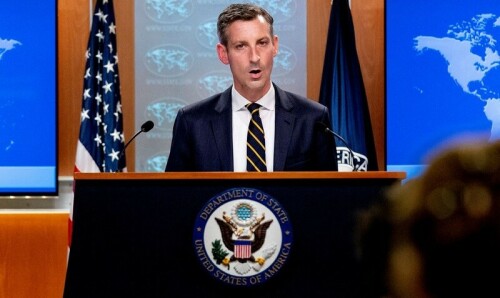
Mr Bhutto-Zardari, who was in Washington last week, discussed this issue with Derek Chollet of the US State Department and, in separate statements, both acknowledged the need to prevent terrorists from expanding their influence in Afghanistan.
In a tweet released after his meeting with the foreign minister, Mr Chollet said that “the US stands with Pakistan in combating terrorism for the safety of all”.
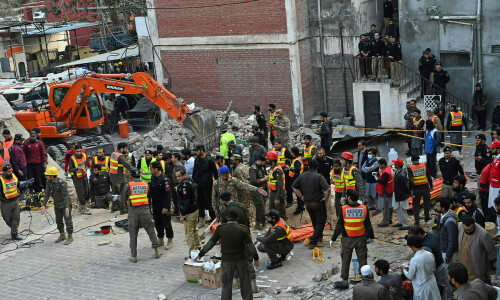
But despite US overtures of support in the wake of several terrorist incidents in recent months — including the attack on a counterterrorism centre in Bannu, Khyber Pakhtunkhwa — it took an attack of the magnitude of the Peshawar Police Lines bombing to prompt the government to take Washington up on its offer.
In his latest statement, US Secretary of State Antony J. Blinken assured Islamabad that “we support the Pakistan government’s efforts to combat terrorism in all its forms and manifestations”.
Adrienne Watson, a spokesperson for the White House-based National Security Council, said that “the United States stands ready to provide support to Pakistan in its efforts to recover and rebuild. Terrorism is indefensible, and to target worshippers is unconscionable”.
All these messages extended “deepest condolences to the families and loved ones of the victims”, underlining a common bond. But what they did not explain is the nature of United States-Pakistan cooperation, i.e. what could the two countries do together to defeat terrorism, other than issuing condemnations.
The first solid indication of a future plan of action came from Mr Bhutto-Zardari, who said the two sides would hold a counter-terrorism conference, probably in Islamabad. He also indicated that Russia, China, and others could be invited to this conference as well, to consider options to deal with this ever-increasing threat.
The coordination question
On Dec 25, the US Embassy in Islamabad issued a warning to American citizens in the Pakistani capital, urging them not to visit a renowned hotel because they had information that terrorists were planning to attack US nationals at the hotel.
Another piece of advice warned Americans to avoid public places across Pakistan, due to threats of terrorism.
Experts in Washington say that the statements made it clear how terrorist groups were coordinating their actions to target both Pakistanis and Americans.
Talking to Dawn, the Pakistani foreign minister said groups like Al Qaeda, the outlawed Tehreek-i-Taliban Pakistan (TTP) and the militant Islamic State-Khurasan (IS-K) group coordinated their activities.
US officials also recognised this link, and in December, Washington added the TTP and Al Qaeda offshoots to its list of global terrorists.
The US also pledged to use the “full set of counter-terrorism tools” available to counter the threat posed by these groups, and to keep militants from using Afghanistan as “a platform for international terrorism”.
Different priorities
But Michael Kugelman, a US scholar of South Asian affairs, noted that “with US forces out of Afghanistan, Washington does not have a strong strategic incentive to partner with Pakistan on counterterrorism issues”.
During a recent appearance on an online talk show, a scholar from the Woodrow Wilson Centre said that while Washington had always looked at Afghanistan through a counter-terrorism lens, the IS-K was certainly a group that the US has been trying to keep an eye on.
The Biden administration, he said, has been trying to develop the capacity to manage and eliminate terrorists in this region, but noted that “the TTP issue is clearly a prominent concern for Pakistan. It’s not much of a concern for the US”.
Mr Kugelman argued that TTP in the past has viewed the US as an enemy, but “we have seen TTP shift its position in a way that it seems to be fully focused on Pakistan right now”.
That’s why, in his opinion, “there’s a bit of a disconnect, a mismatch, between the US and Pakistan on which terrorism threat constitutes the biggest concern. Obviously, for the US “it’s IS-K and what’s left of Al Qaeda, whereas for Pakistan, it’s more TTP”.
In Mr Kugelman’s view, the possibility of “stepped-up intelligence cooperation between the US and Pakistan” to better monitor the movements of terrorist organisations is a distinct possibility, as these threats could impact both US and Pakistani interests in the region.
But, talking about why he does not see scope for a greater counter-terror cooperation between the two, he said the US had frozen security aid to Pakistan for more than five years.“ So, as long as that remains a reality, I do not think we can realistically expect US-Pakistan security cooperation“.
Published in Dawn, February 7th, 2023