Business chiefs in the country are clamouring for the cash-strapped government to allow manufacturing materials stuck at the Karachi port into the country, warning that a failure to lift a ban on imports will leave millions jobless.
Faced with critically low US-dollar reserves, the government has banned all but essential food and medicine imports until a lifeline bailout is agreed with the International Monetary Fund (IMF).
Industries such as steel, textiles and pharmaceuticals are barely functioning, forcing thousands of factories to close and deepening unemployment.
The steel industry has warned of severe supply-chain issues caused by a shortage of scrap metal, which is melted down and turned into steel bars. In the past few weeks, the bars have reached record prices.
“We directly feed materials to the construction industry which is linked to some 45 downstream industries,” said Wajid Bukhari, head of Pakistan’s Large Scale Steel Producers Association.
“This whole cycle is going to be jammed.”
Smaller factories have already shut after exhausting stocks, while some larger plants are just days from closing, he said.
With an import bill of around $150 million a month, the steel industry says its operations directly and indirectly affect several million jobs.
Latest data from the State Bank of Pakistan (SBP) said foreign exchange reserves had plunged to just $2.9 billion — enough for less than three weeks of imports.
“This situation triggers fears the construction industry will close down very soon, plunging thousands of labourers into unemployment,” the Constructors Association of Pakistan said, echoing calls for steel and machinery to be exempted from the import ban.
‘Grinding halt’
Years of financial mismanagement and political instability have damaged Pakistan’s economy — exacerbated by a global energy crisis and devastating floods that submerged a third of the country.
Alongside a shortage of raw materials, soaring inflation, rising fuel costs and a plummeting rupee have battered manufacturing industries.
An IMF delegation left Pakistan on Friday after urgent talks to revive a stalled loan programme ended with no deal, leaving lingering uncertainty for business leaders.
The textile and garment industry is responsible for around 60 per cent of Pakistan’s exports and employs about 35 million people, processing items such as towels, underwear and linen for major brands across the world.
“The textile industry should be prioritised,” said Shahid Sattar, secretary general of the All Pakistan Textile Association.
“We are the mainstay of the country’s exports,” he told AFP.
“If you don’t have exports, how will you shore up your foreign exchange reserves? Then consequently, how will the economy recover?” After floods devastated domestic cotton crops last summer the sector is importing a significant amount of raw fabric.
Factory owners appealed to the finance minister last month for “direct intervention” to unjam the backlog, which also affects dyes, buttons and zippers.
“The textile industry has more or less come to a grinding halt in Pakistan. We don’t have raw materials to operate our mills,” Sattar said.
Around 30 per cent of the textile mills have shut down operations completely, while the rest are working at less than 40pc capacity.
Tauqeer ul Haq, the head of the Pakistan Pharmaceutical Manufacturers Association, said 40 medicine factories were on the brink of closure because of a lack of key ingredients.
Fuelling poverty
Economist Kaiser Bengali said the supply-chain crisis was “feeding inflation and also hitting the government’s revenues”.
It is also escalating unemployment and fuelling poverty, with a large proportion of construction and factory workers in Pakistan paid daily.
“On average during regular production, workers are paid for around 25 days (per month) but now they are getting wages for 10 to 15 days. While some companies have even suspended their production and workers will only get paid once manufacturing resumes,” Bengali told AFP.
Nasir Iqbal, an economist at the Pakistan Institute of Development Economics, said export bans like the one currently in place “can never be a sustainable solution”.
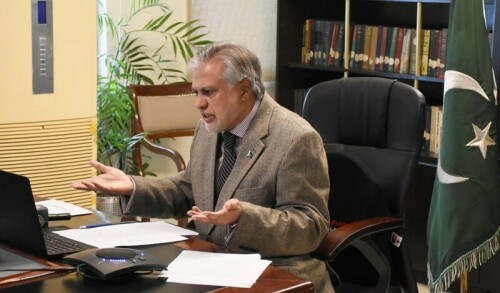
Under-pressure Finance Minister Ishaq Dar last week said businesses must “let the money come in from the IMF” before letters of credit would resume for imports, ending the logjam.
Meeting the conditions of the bailout, such as by raising petrol and energy costs, is also expected to increase inflation, but should pave the way for further financial support from friendly nations.
In the old Silk Road city of Peshawar, factories producing everything from glass to rubber and chemicals, mostly for the neighbouring Afghan market, have closed one after the other in the past several months.
“Around 600 have closed, while many are operating at half capacity,” said Malik Imran Ishaq, the president of the Industrialist Association Peshawar, which represents 2,500 factories.
“The entire business community is in serious trouble.”