Footprints: Justice for innocent coffins


IN Balochistan, they say, there is no dearth of unfortunate news. When word got out that the bodies of Khan Mohammad Marri’s wife and two sons had turned up in a well in Barkhan, the grisly news spread like wildfire.
As expected, the bodies of a woman and Marri’s two sons — their coffins shrouded in white — were brought to Quetta the same night as their fellow tribesmen settled down for a protest on Zarghoon Road, in the city’s Red Zone.
This is where the chief minister and governor’s official residences are situated, and it is where everyone — from the families of the disappeared to protesting teachers and even parliamentarians — gathers to make their voices heard.
Like other protests before it, the demonstration against the killing of the three Marri tribe members drew in people from all walks of life.
Background interviews suggest that the story behind the Barkhan tragedy is one of betrayal. Khan Mohammad Marri used to be a bodyguard for Abdur Rehman Kethran.
However, he was forced to flee the district when the sardar supposedly ordered him to become a witness against his own son, Inam Shah, as the two had fallen out with each other. His refusal meant his death, which is why he fled the province.
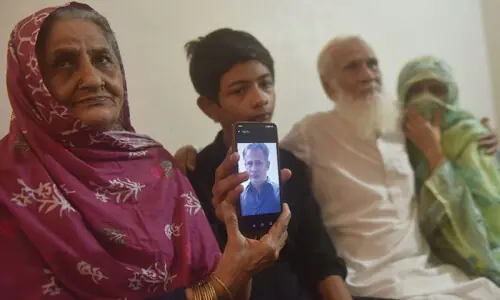
After his escape, the sardar allegedly illegally confined Marri’s wife, Granaz, and his seven children, in his private jail.
In recent weeks, a video of the wretched Granaz had gone viral on social media. Holding the Holy Quran, she could be seen pleading for help. Soon after the video came out, however, the bodies of a woman and Marri’s two sons turned up. The protesters, including the Marri family, hold Sardar Kethran responsible for the killings, a charge he denies.
On Wednesday, the bodies of the three victims lay in two ambulances parked along a blocked Zarghoon Road.
Under a vast canopy, carpets are laid out for protesters to sit. There are banners and placards decrying the sardar and state authorities for their failures. Alongside the men who have gathered here, there is also a strong contingent of women and children, who have come to show solidarity with the victims’ family.
The Marri tribe had been demanding the release of the victims ever since their video went viral, Mehruddin Marri, a leader of the All Pakistan Marri Ittehad, tells me. “No one, including the courts and the media, paid heed,” he goes on to lament. “This is why the sardar had them murdered.”
Like him, others at the gathering are angry too. “The raids at his house were a mere drama,” exclaims Jahangir, general secretary of the Marri Ittehad.
As I approach some of the protesters individually, they all seem to have the same demand: arrest Sardar Abdur Rehman Kethran.
Hajira, a young university student, has been at the protest since Tuesday night. “I have come here so that justice prevails, so that such tragic incidents against women and their children may not take place again,” she tells me when I ask what brought her to this demonstration. “I have come here so that the injustices against the Baloch may stop; I have come here to hope against hope, to demand the arrest of Sardar Kethran, because he has taken law into his own hands, despite being a minister in the provincial government; and I have come here to raise voice against the injustice, which is prevalent in our society.”
As I speak to the protesters, I see that the crowds at the sit-in are continuing to swell. It is evening by this time, and some people are buying tea from local vendors — perhaps realising that they will be there for a while.
Before leaving, I head towards the ambulances to pay my respects to the victims. There is an eerie silence in the evening air; in the distance, a man on a loudspeaker demands justice be done with Sardar Kethran.
Later at night, it was reported that Granaz had been recovered alive along with two of her children, while the body of the woman found in the well belonged to someone much younger, around 17 or 18.
The question still remains, though; will there be justice for the coffins draped in white?
Published in Dawn, February 23rd, 2023