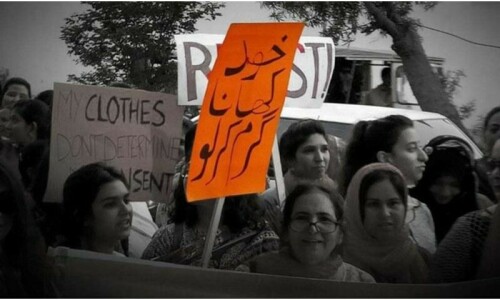
EACH year, the Aurat March takes place in cities across Pakistan to protest against the challenges faced by women and khawaja siras in our society, as well as larger national issues. Apart from specific themes each year, the recurring slogan of the Aurat March is ‘mera jism meri marzi’, the ultimate expression of human autonomy.
The march has made a number of demands of the state which remain unfulfilled, but there has been some pro-women legislation in recent years, and, without doubt, the march has contributed to this. More importantly, the march has politicised people, especially youngsters, by generating conversations around sociopolitical issues. It has also highlighted the need for and desire among women and khawaja siras to occupy public spaces — a right they have been deprived of.
Due to socioeconomic factors, our social makeup has undergone a change over the years. Family structures, gender relations and the aspirations of the young have changed. The culture of dating has found more visibility in public. Meeting and establishing relationships have increased manifold in the last 10 years, especially because of dating apps. Self-will marriages, including court marriages, have increased. Conflicts between parents and daughters increasingly revolve around the latter’s freedom to go out alone, ie, without an escort. It is a battle they are slowly winning as tens of thousands of women leave their homes for work each day — sometimes even for non-work purposes. Moreover, the rising demand for higher education among women is obvious from the fact that thousands of them apply to institutes of higher learning even though only hundreds can be accepted. This demand is reflected in the 2017 census figures.
Young people who visit us (about three a day) have one thing in common: they want a space where they can walk without fear and harassment. Such spaces do not exist in Karachi, except at Seaview — which the real estate lobby is anxious to take over. Weekly bazaars, parks and the zoo all show that multi-gender spaces can exist, without women being harassed. A food street at Burns Road brought families, young men and women together without any overt signs of harassment.
There are new demands of a new generation.
This is where the architect and planner has to come in and cater to the needs of women through the creation of safe, walkable spaces. Unfortunately, where such spaces have been created, the local administration has destroyed them because of its failure to maintain them.
How can architects and planners contribute to the creation of a gender-equitable city? First, and very important, are toilets — clean, with a regular supply of water, and privacy — in all public spaces. It is important for toilets to be specifically allocated for women and khawaja siras for ease of access.
Second is inclusion of women and khawaja siras in the formal economy through design-based elements. The provision of a crèche in all workspaces where children can be looked after is crucial, as is the presence of a well-lit and ventilated workspace (especially in factories), including hygienic spaces for eating. Pedestrianized areas can be created where women should be allowed to set up kiosks to conduct business. These spaces should be well-lit and open till late evening. This will tangibly make women and khawaja siras a part of the city, especially its street economy, and alter gender relations.
That a major change is taking place in the ranks of the younger generation was reflected by a survey carried out by Dawood University students of architecture on what college and high school girls in a katchi abadi wanted to have in a park in their neighbourhood. They wanted a space for playing cricket and table tennis, gym machines, a space for performing, and an open-air library. These are new demands of a new generation of katchi abadi dwellers, and they also resonate with their wealthier, pakki abadi counterparts. Such demands have been reflected in Aurat March’s manifestos and slogans over the years and have received support.
It is imperative that those in the architecture and planning profession, including women professionals, understand these demands in order to create a women-friendly ethos.
This calls for a significant change in the manner in which architects and planners are trained, and for teachers to be trained as well — which requires a major research and extension programme.
In our understanding, if the vision of the city is a pedestrian- and commuter-friendly city, as opposed to a ‘world class city’ (the current vision), this objective can be achieved.
Arif Hasan is an architect and urban planner. Dhuha Alvi is a social development and policy student who enjoys researching the intersections of gender and class with politics.
Published in Dawn, March 14th, 2023