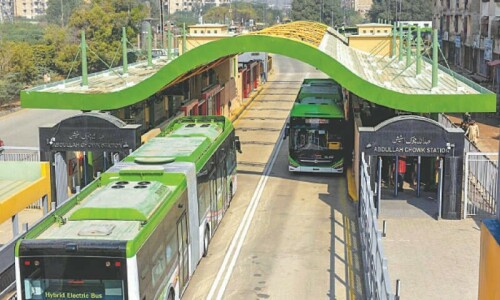
It is needless to say that public transport is fundamental to sustainable urban development and the prosperity of cities. However, Pakistani cities lack a decent and affordable public transport system. This is despite the fact that the country is rapidly urbanising with a growing demand for safe, efficient, affordable and accessible public transport systems.
Public transport in urban areas is generally slow, unsafe, inaccessible, and inconvenient due to inappropriate modes of transport and inadequate and improper route planning. Commuters endure the discomfort and hassle of existing public transport. This not only puts commuters’ safety at risk but also causes discomfort and a waste of their precious time.
Inefficient and disorganised public transport deters labour force participation and effectual use of time and human resources, which have serious implications for individual workers, businesses, and overall society. Furthermore, the existing public transport impedes citizens’ mobility, productivity, and social well-being.
While ride-hailing services took advantage of the situation and aptly filled the gap created by inefficient and disorganised public transport, this has increased the cost of mobility in addition to road congestion, pollution, and increased gender and class inequality.
Research shows the most productive segments of the workforce rely on the public transport system
Despite the immense economic, social, and environmental benefits of public transport, investment in this sector has largely been neglected. As mentioned above, the economic cost of the lack of an affordable and efficient public transport system in Pakistani cities is untenably high. Cities generate a major chunk of economic activity, and a good public transport system is their backbone. However, a lack of good public transport prevents cities from realising their true economic potential.
An efficient and inclusive public transport system can undoubtedly be an equaliser in Pakistani society. This could enable the youth, women, and marginalised segments of society to get equal access to economic opportunities. This includes access to markets, workplaces, health and educational facilities, and social interactions, which are critical to eradicating poverty and overcoming social exclusion.
A good public transport system will enable Pakistan to tap the potential of its relatively young and digitally literate population, which can massively change the socio-demographic profile of Pakistani society.
Good public transport not only improves the quality of life in urban areas but also allows the rural and the periphery area population to contribute to and benefit from the economic activity in urban centres.
Hence, it is safe to say that the ease of mobility can significantly encourage labour force participation to reduce social inequity and gender and class inequality seeping into Pakistani society. As for gender inequality and inequity, a 2015 study by the Asian Development Bank shows that 40 per cent of Pakistani women cannot access healthcare services due to a lack of availability of public transport.
Recently, I led a study under the Research for Social Transformation and Advancement (RASTA) competitive research programme of the Pakistan Institute of Development Economics, which investigated commuters’ preferences for public transport in three cities of Pakistan: Karachi, Lahore, and Islamabad.
The findings revealed that roughly one-third of the surveyed commuters in the three main cities of Pakistan were women, and almost half the respondents were below forty years of age. This clearly shows that the most productive workforce in Pakistani uses public transport, and any improvements in public transport will have a clear advantage in terms of an increase in their output and hence their contribution to economic growth and social development.
Plausibly, commuters disliked greater access time, which is determined by the distance to the nearest stop, which suggests crafty mapping of public transport routes to create an ease of access for commuters to use public transport. In this respect, we recommend designing a good feeder-trunk system to help reduce the access time for public transport for commuters from the periphery areas of the three cities.
It is interesting to note that reserved ladies’ seats and Wi-Fi are crucial to attracting young commuters, including women, to use public transport more often. As for the safety and appropriateness of public transport modes, commuters in three cities preferred buses over other modes of public transport such as vans.
Notably, almost all survey participants expressed their displeasure with transfers — a change in the public transport mode within a journey. This is due to the inherent discomfort at public transport stops and an increase in overall travel time.
This research also investigated the commuters’ willingness to use a car-pool system and results show that commuters are willing to use and pay an additional fare for such a system. In the age of ride-hailing services and the frequent use of mobile applications, introducing a car-pool system could be a cheaper option from the public transport authorities’ point of view.
Most importantly, this can put a significant fraction of cars off the road, resulting in lesser road congestion, pollution, and subsequent health hazard. The reduced road congestion could also decrease the probability of fatal road accidents and the subsequent loss of precious lives.
The writer is an academic with a PhD in economics and works as a social protection consultant for the government of Pakistan
Published in Dawn, The Business and Finance Weekly, March 20th, 2023