ON a cold morning in January 2018, four senior judges of India’s supreme court mounted a revolt against their chief justice. Addressing a press conference, the dissident judges lamented the “selective assignment of cases to preferred judges” and the chief justice’s recalcitrance to structure such unbridled discretion. Contemporaneously, Pakistan’s chief justice had embarked on a mission to build dams and reform the healthcare system, notwithstanding the flood of litigation and the ailing justice system he had inherited.
While the events in India ought to have led to revisiting the discretionary powers of the chief justice of Pakistan, CJ Nisar did exactly that which had ruptured the Indian court. In May 2018, he summarily reconstituted a bench comprising Justice Isa after the latter raised questions regarding the contours of the court’s suo motu jurisdiction.
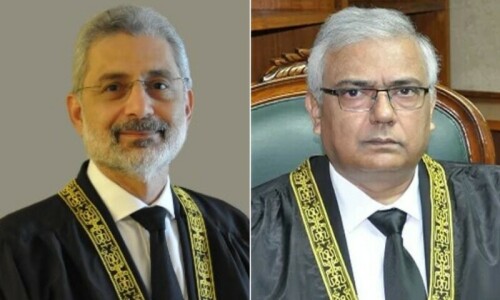
Expressing his views on the unwarranted reconstitution, Justice Shah, who was the third member of the same bench, warned that any effort “to dampen an alternative viewpoint of a member on the bench, would shake the foundations of a free and impartial justice system”.
While the retirement of CJ Nisar closed an unfortunate chapter in our judicial history, the fissures which had first emerged during his tenure would only be accentuated. By the time of his retirement, the ‘hybrid regime’ had become entrenched.
Critical to the survival of any authoritarian regime is the suppression of all dissent, the dissemination of hyper-nationalist rhetoric, intimidation of the media, and the emasculation of the judiciary.
Soon after his unlikely election as the leader of the free world, Donald Trump, for instance, responded to the court of appeals’ decision to block the government’s travel ban by declaring that “the opinion of this so-called judge essentially takes law enforcement away from our country”.
Unsurprisingly, the authoritarian project foisted on us since 2017, too, attempted to undermine the custodians of the guardrails of our democracy.
It may be time to structure the chief justice’s powers.
By May 2019, a malicious reference had been filed against Justice Isa based on the spurious allegation that he failed to disclose his family’s properties. Selective leaks to the media, press conferences by members of the government, and the alleged doling out of funds to lawyers who supported the reference betrayed the regime’s desire to subdue the judiciary.
Those who refused to be collaborators were consigned to irrelevant benches and excluded from the hearing of politically consequential cases.
By the time the Supreme Court decided the fate of the reference against Justice Isa, the chasm between its judges was palpable.
Alluding to the discord between judges in his farewell speech, Justice Maqbool Baqar bemoaned the “manner in which we have disagreed with each other recently”, and the exclusion of judges from the hearing of sensitive cases due to the impartiality of their views.
Writing for these pages in September 2022, this writer had suggested that it may be time to structure the chief justice’s powers to constitute benches under Order XI of the Supreme Court Rules, “so as to entail meaningful consultation with the two senior-most judges of the court, thus making the process more inclusive and transparent”.
The importance of structuring such powers may be conspicuous from the fact that since 2020, Justice Isa, the senior puisine judge of the court, has been involved in less than five reported cases emanating from the court’s original jurisdiction. Juxtaposed with Justice Isa, however, Justice Ijaz ul Ahsan was involved in more than 20 cases across the same period.
While this is not to suggest that that the inclusion of certain judges in the hearing of politically consequential cases is calculated to achieve specific outcomes, the exclusion of judges whose views have often differed with that of the chief justice raises concerns about the integrity of judicial decisions and the chief justice’s ability to act as a fiduciary of the people. Unsurprisingly, the recalcitrance to regulating such powers has irreparably ruptured the court.
While CJ Bandial may not have chosen the circumstances in which he inherited the apex court, his legacy hinges on his ability to steer the Supreme Court from the treacherous waters it finds itself in.
The road to reform begins with dialogue and understanding that the powers enjoyed by the chief justice are not personal to the individuals who momentarily hold such offices. With CJ Bandial set to doff his robes in September this year, would he have the gumption and wherewithal to assuage such concerns and regulate the “one-man show enjoyed by the office of the chief justice of Pakistan”, or will his successor be left to pick the ashes of a fractured court? The polis is falling apart!
The writer is a lawyer
Twitter: MoizBaig26
Published in Dawn, April 3rd, 2023