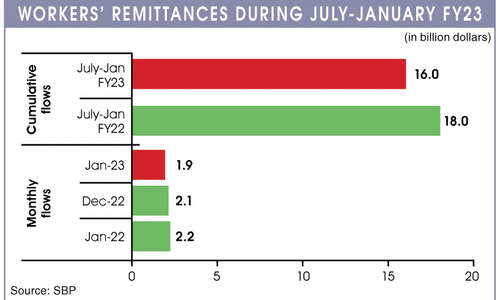
KARACHI: Due to the Ramazan factor, the remittances sent by overseas Pakistani workers grew 27.4 per cent month-on-month in March, but the country lost $2.5 billion in the first nine months of FY23 due to an artificial exchange rate cap.
The State Bank of Pakistan (SBP) reported on Monday that remittances rose to $2.5bn in March against $1.9bn in February. However, the inflows dipped 10.71pc when compared with the $2.8bn the country received in March last year.
Bankers and currency dealers were expecting higher remittances as overseas Pakistanis used to remit more in the holy month for their families and also for charity purposes including Zakat. Currency dealers said remittances usually increase in the range of 15 to 20pc during the fasting month.
“With the cumulative inflow of $20.5bn during the first nine months of FY23, the remittances recorded a decline of $2.491bn when compared with $23.018bn remitted during the same period last year,” the central bank data showed.
Inflows witnessed 27pc growth in March due to Ramazan factor
However, the most significant part of the data was a 10.8pc or $2.5bn decline in remittances during the July-March period of the current fiscal year, while the country’s economic managers are struggling to revive the $7bn International Monetary Fund programme for securing the release of $1.1bn tranche.
The government has met all the prior conditions, but IMF is still not ready to release the tranche. The Fund now wants written assurances from friendly countries for financing Pakistan’s external debt repayment gap for FY23.
On Thursday, Minister of State for Finance & Revenue Dr Aisha Ghaus Pasha announced that Saudi Arabia had conveyed its commitment to the IMF for its bilateral financial support to Pakistan.
She hoped similar assurances from the UAE or some other source would help reach a staff-level agreement (SLA) with the Fund which would unlock multilateral disbursements.
The currency experts had been warning the government to remove the unreal dollar cap as the grey market was offering Rs30-40 per dollar higher prices than the interbank and open markets rates. The financial market believes this wide rate gap encouraged the diversion of $2.5bn remittances to illegal channels.
The government finally uncapped the exchange rate at the end of January which appreciated the dollar abnormally high against PKR but the inflows of both the remittances and export proceeds increased substantially since then.
The highest decline in remittances was noted from Saudi Arabia as it fell by $918m (15.7pc) to $4.910bn during the July-March period against $5.828bn in the same period last fiscal year.
Except for the United States, the remittances from all destinations declined during the period under review. The inflows from the US increased by 3.2pc to $2.28bn.
Overseas Pakistanis based in UAE and UK remitted $3.604bn and $3.053bn, posting a decline of 16pc and 4.4pc respectively. Despite a decline of 9.5pc, Pakistan received $2.417bn from GCC countries.
The inflows from the EU countries declined by 6.9pc to $2.334bn but the inflows during the last 5 years have been increasing from EU countries.
Published in Dawn, April 11th, 2023