“Justice is what the judge ate for breakfast.” — Jerome Frank, legal realist philosopher
SIX recent judicial orders — one order of the Supreme Court and five orders of the Islamabad High Court — in two days (May 11 and May 12), restraining the authorities from arresting Imran Khan, has converted the PDM-PPP government into hard core legal realists of the kind captured by the quote above. These judicial orders have also, post-facto, reaffirmed the alleged correctness of the sole legal and judicial strategy of the government’s legal team: whenever you lose a case partly due to your own incompetence, tell everyone that the judge has been influenced.
But is the PDM-PPP government correct in its judicial fairytale analysis that these allegedly ‘defective’ judicial orders are the result of an alleged bias in favour of Imran Khan? Or is Imran Khan correct in constructing his alternative judicial fairytale analysis that these decisions are strictly a product of the application of the Constitution and the law, without any extraneous influences and predispositions?
The paradox: After over 100 registered cases, an assassination attempt, assaults on his home, the large-scale prosecution of PTI leaders and workers, a proxy case seeking his political disqualification on the non-disclosure of his alleged daughter, Tyrian White, and even a case questioning his nikah, can anyone seriously doubt that Imran Khan is the subject of systemic political vendetta and state repression?
If we are honest enough to admit these facts then what is so legally extraordinary about the relief of no-arrest and protective bail, for a very limited period only, granted by the SC and IHC to Imran Khan? The government cannot seriously challenge the legality of these six judicial orders for two main reasons.
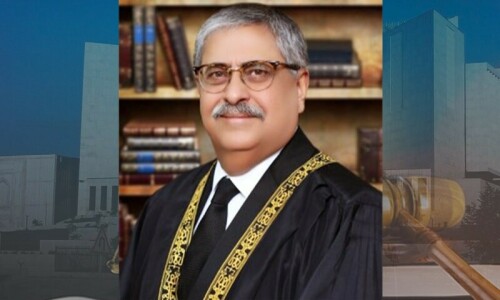
Firstly, the SC order dated May 11, 2023, was passed by a three-member bench which also included Justice Athar Minallah. Is the government now alleging that even Justice Minallah is ‘biased’, someone whom the government only recently celebrated as a great dissenting SC judge? Secondly, no serious lawyer or legal scholar can question the legality of such limited and temporary no-arrest relief by the SC and IHC.
Therefore, the main focus of their critique has been on the extraordinary speed and generosity of this legally correct relief — this speed and generosity, they allege, tends to show bias in favour of Imran Khan. Therefore, the apparent paradox of how such judicial relief can be both legally and constitutionally correct but might exhibit alleged bias needs to be explained.
Most judges cannot escape the constraints imposed by the Constitution and the law.
Beyond fairytales: In periods of relative democratic rule in Pakistan, even in highly politicised cases, most judges cannot escape the constraints imposed by the Constitution and the law. But this is subject to the two caveats of contested interpretations and judicial discretion.
Both the Constitution and the law allow judges to adopt differing judicial interpretations of the Constitution and the law, and thus also allow judges enough judicial discretion to either deny or grant judicial relief to individuals in similar circumstances. This ‘undefined space’ created by differing interpretations and judicial discretion is filled with fear, desires and visions which judges experience and express in their judicial role.
As Justice Oliver Wendell Holmes observed: “The life of the law has not been logic: it has been experience. The felt necessities of the time, the prevalent moral and political theories, intuitions of public policy … even the prejudices which judges share with their fellow-men…”.
Judicial interpretations and discretion, although controlled by the Constitution and the law, are also influenced by the fear of losing judicial power or privileges, by judicial desires and visions coloured by their political and social views and class, gender and geographical backgrounds. Like all of us, judges are also human beings.
Fear, desires and visions: Two key judicial cases document both the acceptance and denial of the Pakistani judge’s apprehension of the coercive power of the state. Firstly, the contempt case against retired Gen Mirza Aslam Beg (1993), where it was alleged that he had sent a message to the SC not to restore the dissolved National Assembly of the Junejo government. Gen Beg recanted and the SC went into denial.
Secondly, the challenge to the Eighth Constitutional Amendment recorded in the Mahmood Achakzai case (1997). In this case, Justice Saleem Akhtar records the admission of Syed Sharifuddin Pirzada that he had, by implication, threatened CJP Anwar-ul-Haq with his removal as CJP if Gen Zia was not given the power to amend the Constitution.
After recording this damning admission, the SC slumbered in silence. These are actual cases of interference, but generally, there is apprehension among judges of the tremendous coercive power of the state, especially the deep state. No wonder, the cases of missing persons have witnessed judicial silence, with former CJP Iftikhar Chaudhry and former CJ Athar Minallah and the IHC being exceptions.
Moreover, judges, while interpreting the Constitution, which is replete with political ideology and values, appear to act like applied political theorists, as David Robertson explains in his book Judges as Political Theorists. Political and social views influence judicial desires and visions, which in turn structure legal interpretations. Isn’t the US supreme court publicly perceived as being composed of bitterly divided Republican and Democratic judges?
Also, judges are influenced by their class, gender and geographical backgrounds. Can anyone deny that the rich and middle classes have a better chance of getting much speedier relief than the poor? Further, one of the differences between the judicial interpretation of Article 63A of the Constitution, by Justice Munib Akhtar and Justice Mandokhail might stem from their geographical origins. A judge from Balochistan might show more sympathy in giving politicians the benefit of the doubt.
The key is not to wish for super human judges without predispositions but for greater judicial accountability and transparency to expose biases and a more representative judiciary which represents our (all too human) predispositions.
The writer is a lawyer.
Published in Dawn, May 18th, 2023