Missing resilience


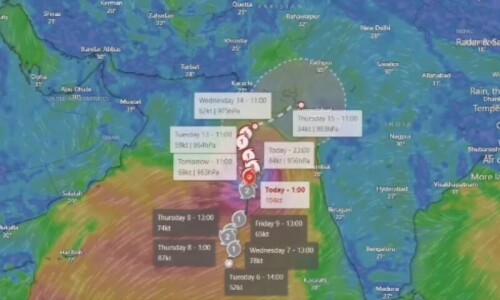
KARACHI’S history of natural disasters remains obscured, just like its original topographical contours. As the cyclone Biparjoy, meaning ‘disaster’ in Bangla, sets its sights on this city of over 200 million, ordinary Karachiites find solace in the common refrain: ‘Abdullah Shah Ghazi won’t let disaster befall us.’ However, it appears that they have forgotten that cyclones have indeed struck Karachi multiple times throughout history.
One such cyclone in 1944 rendered 10,000 people homeless when the city’s population was less than half a million. Back then, Karachi’s marine ecosystem was still intact, with two key lagoons, Obhayo and Nai Nar, as well as two creeks, Korangi and Gizri, existing alongside their sub-creeks. Karachi faced two other significant cyclones in 1902 and 1964. Given the severe degradation of the city’s marine ecosystem today, one must question the disaster preparedness incorporated in its urban planning.
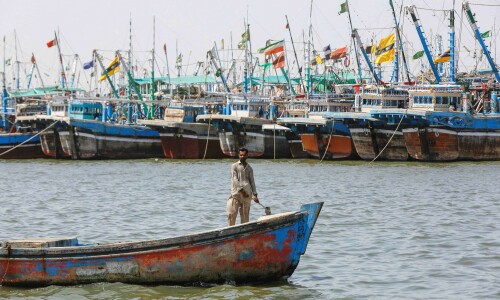
Regrettably, the transformation of Karachi’s landscape has left little room for disaster resilience. Gizri Creek, once a thriving ecosystem, is now a housing settlement, leaving Korangi Creek as the sole remaining waterway. The largest lagoon, Obhayo, has been reduced to a polluted black water pond called Boat Basin, surrounded by housing settlements such as Hijrat and Shireen Jinnah Colony. The Mai Kolachi Bridge severed the remaining lagoon from the open sea, disrupting a critical function of the marine ecosystem. Similarly, the disconnection of another significant lagoon, Nai Naar, at Sandspit in the 1950s halted the natural high tide-low tide cycle that previously cleansed the Keamari Harbour. Consequently, severe pollution in the area, especially in and around the fish harbour, led to a ban on fish exports to the EU.
Karachi typically experiences average annual rainfall of less than 175 mm. However, recent occurrences have showcased extraordinary variations in precipitation. In August 2020, Karachi witnessed a significant downpour, with rainfall recorded at 223.5 mm. Similarly, the previous year saw a remarkable 1050 mm of rainfall in Bahria Town.
Cyclones have struck Karachi multiple times.
Unfortunately, each year, the regular monsoon rains wreak havoc on the city, leading to substantial damage. In comparison to other coastal cities in Asia, Karachi’s average rainfall is considerably lower. For instance, Goa and Mumbai receive an average of 3000 mm and 2200 mm respectively, while Jakarta receives over 1800 mm. It is noteworthy that despite the higher rainfall in these cities, they continue to function normally without municipal emergencies, unlike Karachi, where even a downpour of less than 200 mm can trigger such situations.
If Karachi were to face a severe cyclone or experience unusual rainfall, the consequences could be devastating. The once-efficient backwater absorbing capacity of Obhayo lagoon and Gizri Creek has been lost, while the blocked waterways of the Lyari and Malir rivers threaten further harm to the city’s infrastructure and its inhabitants.
The 2001 earthquake in Gujarat, India, serves as a grim reminder of the potential devastation that can occur along the Allah Band seismic fault. Throughout history, the coastal region of Sindh and Gujarat, India, has experienced a series of major and minor earthquakes along this fault line. One significant earthquake, in the eighth century, had its epicentre near Jungshahi and resulted in the destruction and submergence of Debal port. Similarly, the 1668 earthquake, as reported by European travellers, devastated ‘Auranga Port’ or ‘Samawani’ submerging 30,000 houses and claiming 50,000 to 150,000 lives. Another earthquake in 1819 wreaked havoc on Sindhri Port, located near the Pakistan-India border south of Badin. Further, the last recorded tsunami to hit Karachi occurred in 1945, with a British newspaper estimating 4,000 casualties along the Makran Coast.
Karachi has undergone an exponential population increase, from 4m in 1980 to 10m in 2000, leading to haphazard expansion and the proliferation of poorly constructed concrete structures. Urgent action is needed to develop disaster risk reduction strategies and implement bold measures to enhance the city’s resilience against disasters and climate change. Central to achieving this goal is the restoration of Karachi’s marine ecosystem. Failure to do so not only jeopardises Pakistan’s commercial capital but also endangers the lives of over 10pc of the country’s population.
In addition to its vulnerability to natural disasters, Karachi faces a significant concern in the form of air pollution. Industrial activities, vehicular emissions, and a lack of vegetation contribute to the city’s heavily polluted air. The absence of trees further exacerbates the risk of heat-related illnesses.
The writer is a climate justice activist and founder of the Clifton Urban Forest, Karachi.
Published in Dawn, June 13th, 2023