Seventeen-year-old Bakhtawar Abdul Ghaffar is the recipient of much cheering and applause from her neighbours for her outstanding performance during a football match. Not only are they fans of her game, they also appreciate her for her leadership role in training and coaching many of their daughters in football.
Living in Lyari’s Moosa Lane, playing football was a difficult needle to thread for Bakhtawar. But she has been playing football for eight years now while facing up to the many challenges that have come her way.
“Before I started playing football, I used to watch boys playing in our street and I also wanted to play like them,” says Bakhtawar, who made friends with the boys in order for them to let her play with them. However, she met with fierce criticism from the neighbourhood. Almost all of her neighbours objected to a young girl playing football on the streets with a bunch of boys.
“Still, my family stood by me,” she smiles.
She then moved from the street to playing football at Lyari’s famous Kakri Ground. By this time, there were two girls in the boys’ team — Bakhtawar and Meher Jan. One girl breaking the norm had opened the door for another on the team.
Football is no longer just a men’s sport in Lyari. Meet the Baloch women footballers, who are breaking all social barriers to stay on the field
Meher Jan plays all kinds of sports — she is also a cyclist, though football is her first love. Still, Kakri Ground has always been dominated by male footballers and playing there with the boys, the girls stuck out like sore thumbs. Later, a couple of more girls joined them there. They were all looking for acceptance by showcasing their talent.
“Seeing us playing in the ground was a jaw-dropping experience for the male players,” recalls Meher Jan. “But what they found even more shocking was that the girls were playing along with the boys. But we stood firm. We held our ground and kept on playing, which was easier said than done,” she admits.

“Given the notorious track record of Lyari, especially Lea Market, which I cross to reach Kakri Ground for practice, I am severely criticised by relatives and neighbours for going there alone,” says Meher Jan. “I also know that the game not being a source of earning also plays some part in this, because I am also told that I am wasting my time playing football,” she says.
“But also being an artist, working at decorating stages and rooms [for events such as weddings], I am able to earn enough to manage my football expenses,” states Meher Jan.
Things started looking up more for the Lyari girls after 2021, when Woman Is a Nation (WIN), a local non-profit organisation with an aim to instil skills of leadership and fair play in girls through sports, held its first football talent hunt event.
Through a programme titled ‘Lyari Kick’, WIN was able to coax out from the community some 50 girls, who had also dreamed of being able to play the game out in the open. Suddenly, there was no need for one or two girls to play in boys’ teams. There were enough of them now to form their own teams. Among these girls was another young star Shamsa Shahnawaz who, like Bakhtawar, hails from Moosa Lane.

Shamsa, 16, is the goalkeeper of the community girls’ team. Known as an ‘emotional player’, Shamsa likes going to the Gabol Park Ground for practice. The ground is packed with boys the entire day.
“Initially, I used to be taunted and undermined by the boys at Gabol Park,” says Shamsa. “But after playing with them and proving my strength in the game, I was encouraged by the same boys to play.
“It’s just a matter of proving one’s skills and showcasing them at the right time and right place, which makes a difference,” Shamsa asserts. After seeing her play, Shamsa’s younger sister also joined her.
Mehreen Shoukat, WIN’s coordinator and coach, says she has been striving to establish a football club for girls in Lyari. “I have been coaching girls in football for some five years now,” states Mehreen, who can also share a few of her own stories of disapproval from men when they found out she was into football.
“I was once travelling in a rickshaw in my tracksuit with a football in hand when the driver asked if I played football. On my saying yes, he asked, ‘With such hobbies, who would marry you?’” shares Mehreen.
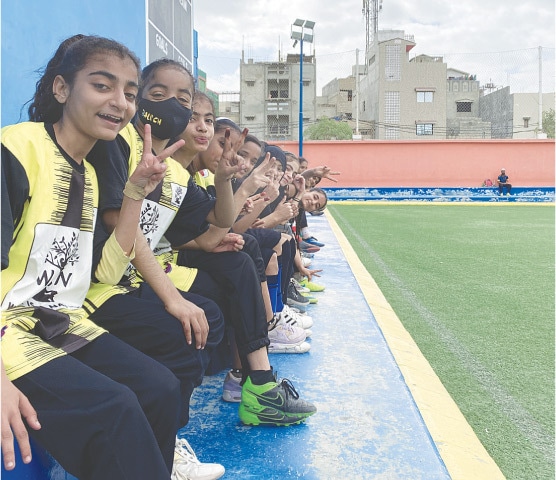
Initially, girls playing in tracksuits was central to the interminable criticism unleashed at them. Determined to encounter this, Mehreen came up with a novel idea of showing that girls could play football regardless of what they wear during the game.
“We organised an event ‘Fair Play’, with the aim of bringing more girls from the community to play football in their cultural dresses. Again, some 50 girls from the community participated in the event, while playing in Baloch dresses,” Mehreen adds.
Jawed Arab of the Jawed Arab Football Academy (JAFA) has been coaching male players for more than 30 years now. But training female players is also now a significant part of his job.
“To beat all odds standing in the way of coaching girls, I brought my 14-year-old daughter into the field first,” he says.
Arab has coached nine Pakistani international female football players thus far. However, throughout his career as a player and coach, he has come across several issues that need to be taken into consideration for female players.
“The biggest problem here is the early marriage of girls,” he points out. “They get engaged or married in the middle of their careers, bringing it to an abrupt stop.”
Another thing, he says, is that when they are playing under the umbrella of the Pakistan Football Federation (PFF), the girls get the necessary training and remuneration, but after they return home, they are left to fend for themselves.
“Though PFF has been doing a tremendous job, there needs to be a proper social as well as financial security plan for talented players in the long run,” he says. “This must include their educational expenses as well. It will help them focus better on their skills development, without having to constantly worry about other things.”
The writer is a member of staff.
He tweets @Ayaz_Juno
Published in Dawn, EOS, July 2nd, 2023