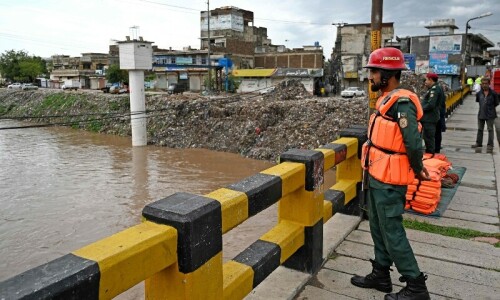
The federal cabinet on Wednesday approved the National Adaptation Plan 2023 which is aimed at protecting communities that are vulnerable to the adverse impacts of climate change.
The cabinet approved the plan on the recommendation of the Ministry of Climate Change.
An official handout from the Prime Minister’s Office (PMO) said that under the plan, the government, along with other stakeholders, would take measures to protect vulnerable communities from the adverse effects of climate change.
These steps would include early warning systems and effective measure to cope with emergency situations, the handout said.
Climate Change Minister Sherry Rehman thanked her cabinet colleagues and Prime Minister Shehbaz Sharif for approving the plan.
“Great service to Pakistan as it faces adaptation and resilience challenges,” she said, as she also thanked her team at the climate change ministry.
Responding to Rehman’s tweet, PM Shehbaz said that that climate change was “redefining every human experience on the planet”.
“In the long journey to build resilience, our government is proud to pass our country’s National Adaptation Plan, which will give Pakistan the essential tools to adapt to the risks of climate stress,” he said.
“As last year’s devastating floods showed, climate change is a development, economic, human and national security issue critical to the future of our people. All the more reason to invest in climate adaptation to build our core capacities to fully cope with the challenge,” he said.
The premier also appreciated the efforts of the climate minister, her team and other stakeholders for their hard work.
Addressing a press conference later in the day in Islamabad, the climate change minister stated that Pakistan had become “ground zero” for global warming.
She said that last year’s floods in Pakistan were not a “random incident” and should not be classified as a natural occurrence. She added that Pakistan was now one of ten countries most vulnerable to climate change.
“It is a hotspot now,” Rehman said. “If you are breaking the record for the highest temperature for the past three years then that means you are top of the list,” she added.
Pakistan, which has the world’s fifth largest population, is responsible for less than 1pc of global greenhouse gas emissions, according to officials. However, it is one of the most vulnerable nations to the extreme weather caused by global warming.
Last summer, unprecedented monsoon rainfall had put a third of Pakistan under water, damaging two million homes and killing more than 1,700 people.
According to the latest report by the National Disaster Management Authority (NDMA), 150 people have died in the country while 233 have been injured since June 25 due to the latest spell of monsoon rainfall.