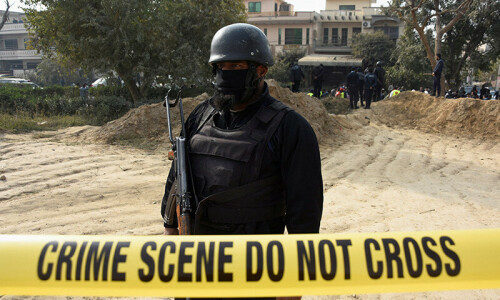
VISIT any part of Balochistan and you’ll see what’s considered abnormal elsewhere, is normal here. Along highways and major roads, hilltops bristle with Omani-style forts with machine guns peering down from the heights.
On the plains, bunkers and checkposts abound. In my low-end rented car with a local driver, time after time we were stopped and interrogated until I lost my cool.
Why must I repeatedly prove my credentials in my own country? Which foreign power is occupying us? Thereupon a Frontier Corps officer was summoned to deal with a noisy case.
The remainder was pleasant enough. An avid YouTube watcher, Captain X from Kharian ordered tea and biscuits. As trucks laden with fuel smuggled from Iran were waved on by his men below, we entered a long conversation.
He was here for protecting us all. Gesturing towards distant Khuzdar which had recently seen a bomb attack, he said he was on a two-year deputation. Protection was needed against Baloch separatists and TTP terrorists.
Why, I asked, not leave security matters to the Baloch Levies and local police? He sighed. Yes, this should happen sooner rather than later. He did not relish being viewed by the locals as a Punjabi occupier and wanted to be home asap. As for stopping fuel smuggling, that was above his pay scale. It made sense. We parted with a handshake and traditional hug.
Checkposts thickly dot Abbottabad as well. My last visit was years before Osama bin Laden magically popped up in 2011 and put this KP city on the world map. The checkpoints looked new to me. Why now? Are we near the military academy? Has something bad happened recently?
Security doesn’t explain why you are stopped again and again at checkpoints by gun-toting soldiers.
No, said my host, the barriers are new and this is not the cantonment area. He could not explain the increased numbers. Nevertheless, seeing a Land Cruiser approaching with two respectable-looking people in it, the barrier was raised each time we approached. One soldier saluted us. Perhaps he thought we were retired officers.
Security is a fake excuse for the ubiquitous khaki presence. Visiting Gilgit-Baltistan two weeks ago left me convinced. Amid snow-covered mountain peaks, this idyllic region is the gentlest and most peaceful part of Pakistan. Nevertheless, for some unfathomable reason, officers stationed in this popular tourist destination get a 25 per cent ‘hardship allowance’.
Well over 100km away from the Line of Control, with the toughest possible terrain in between, it is inconceivable that Indian forces could march into Gilgit. Moreover, the last episode of Shia-Sunni violence in the area was well over 10 years ago.
The crime rate is relatively low and drivers are less aggressive than in big cities. Local people have demonstrated against inflation, doling out mining rights, and the acquisition of large tracts of land by the army for cadet colleges and CPEC projects. But these were peaceful protests.
Why is such heavy, assertive presence needed in our so-called ‘smaller provinces’? Why is Lahore, which is just a stone’s throw away from the Indian border, practically free from checkposts and the overbearing presence of uniformed soldiers?
To seek an explanation, let’s revisit the Melian Dialogue. Held between the soldiers of Athens and people living on the island of Melos, this classic exchange of 2,000 years ago showcases the clash between power and morality. The Athenians say that they would be justified in occupying Melos because they are stronger. The Melians, who are an older culture, argue for self-rule as their right.
The Athenians contend that the strong invariably do what they can and the weak suffer what they must. In international relations, there is no such thing as justice, only power. Therefore the Melians would be better off surrendering now rather than suffering a worse fate later. In turn, the Melians plead that they have done nothing wrong to the Athenians.
Athenians: What we shall do now is to show you that it is for the good of our own empire that we are here and that it is for the preservation of your city. We do not want any trouble in bringing you into our empire, and we want you to be spared for the good both of yourselves and of ourselves.
Melians: And how could it be just as good for us to be the slaves as for you to be the masters?
Athenians: You, by giving in, would save yourselves from disaster; we, by not destroying you, would be able to profit from you.
Melians: So you would not agree to our being neutral? You can invade elsewhere if you want.
Athenians: No, because it is not so much your hostility that injures us; it is rather the case that, if we were on friendly terms with you this would be seen as a sign of our weakness, whereas your hatred is evidence of our power.
This dialogue, repeated in various shapes and forms over the centuries, remains instructive. Rulers assert their power through highly visible means such as checkpoints and barriers. Of course, Pakistan is not the only country in the world with a strong centre and weaker opponents in the periphery.
But this is not how things should be. The challenge to federal control posed by Pakistan’s ethno-nationalists can be countered by allowing integrative forces to play their role. These forces arise from the natural advantage of being part of a larger economy with correspondingly greater opportunities.
For them to be effective, it is essential that the state machinery provide effective governance, demonstrate fairness, and show indifference to ethnic origins. Insensitivity to this has had tragic consequences for Pakistan. The lessons of 1971 were never learned.
The Pakistan Army, as the name says, is Pakistan’s army. Needed for defending national borders, its allegiance must be to all the peoples of Pakistan and not just to those of one province. Its footprint across the country should be only as big as strictly necessary and no more.
Unnecessary checkpoints suggest a ruler mentality. Those in uniform must be seen less often, stay away from meddling in politics, and do more to fight the rising tide of TTP terrorism.
The writer is an Islamabad-based physicist and writer.
Published in Dawn, August 26th, 2023