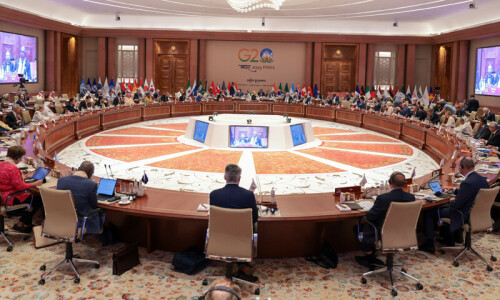
SEVERAL noteworthy developments occurred at the just concluded G20 summit in New Delhi, reflecting the rapid state of flux the international order is experiencing.
The grouping of the world’s 19 top economies, along with the EU, just admitted the African Union, while Xi Jinping was conspicuous by his absence, sending an unsubtle message to the host nation as well as Western members of the bloc. Vladimir Putin also stayed away.
Though the official declaration denounced the use of force and violation of the territorial sovereignty of any state, there was no express criticism of the Russian invasion of Ukraine, a compromise solution that was reportedly reached to bridge the wide geopolitical differences between members of the grouping.
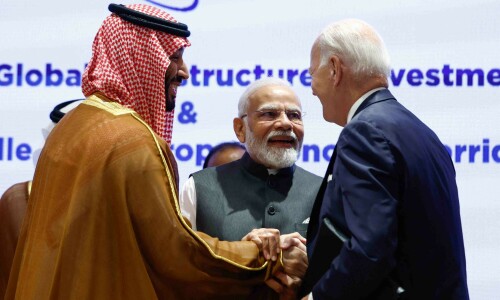
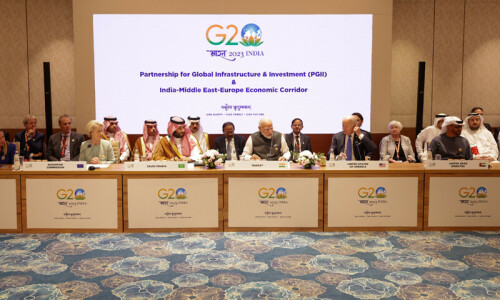
Another major announcement was the launch of the India-Middle East-Europe Economic Corridor, a massive scheme described as a modern ‘Spice Route’ designed to link India with Europe, via the Arabian Peninsula.
Termed a “real big deal” by Joe Biden, the project is being seen as a rival to China’s Belt and Road Initiative that involves transcontinental transportation, energy and data linkages.
From the aforesaid details, it appears that the G20, as well as the G7, are trying to transform themselves from West-led old boys’ clubs to more ‘inclusive’ organisations ready to invite more states from the Global South.
The expansion of BRICS and the SCO may have played a role in these changed priorities, which is why the AU has been courted as a partner. Geo-economics and geopolitics are also at play, with the Spice Route taking an aim at the BRI and the Russia-led International North-South Transport Corridor.
Despite being a G20 member, Beijing was not invited to join the new project linking India and Europe. The scheme will also come in handy by connecting Israel with the Arab states.
The building of multiple transcontinental energy and trade corridors is not necessarily a bad thing, as competition can be healthy, while developing states can prosper by attracting investment and serving as conduits in these expansive networks.
Where Pakistan is concerned, due to our internal issues, we are largely spectators rather than active players in these transnational geo-economic networks.
Unfortunately, we have not even fully utilised the potential that CPEC, a BRI project, was supposed to bring.
Pakistan must also realise that despite India’s atrocious human rights record in held Kashmir, the West, as well as our Muslim brothers, seem least concerned and are eager to do business with Delhi. The sad reality is that in the international arena, economic heft overshadows morality.
Therefore, if we want to be part of these global trade networks, and if we want our voice heard where issues such as Kashmir are concerned, we need to first address our internal inadequacies.
Published in Dawn, September 12th, 2023