Monetary policy rethink


MONETARY POLICY in Pakistan follows an eclectic approach that often shifts between prioritising price stability and economic growth. Currently, we are trapped in a situation where we have neither achieved low and stable inflation nor desirable economic growth.
A transparent monetary policy is one in which the central bank clearly communicates its commitment to a goal — in Pakistan’s case achieving price stability — and how it intends to get there. Credibility is attained when the central bank’s actions are consistent in this direction.
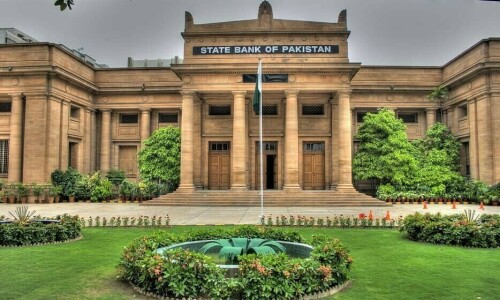
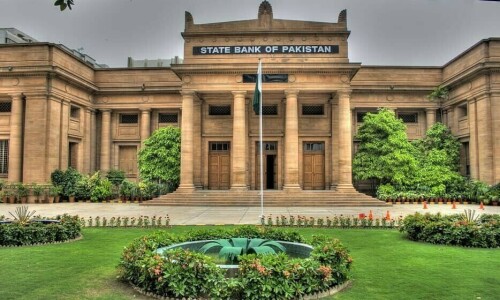
However, the State Bank of Pakistan’s (SBP) hard-earned credibility has been compromised in recent years due to its inconsistent monetary policy decisions, necessitating urgent introspection.
First Pakistan’s ongoing external sector challenges are a major cause for concern. Between 2013 and 2017, amid low interest rates globally and an IMF programme, the government borrowed heavily from international sources. This unchecked borrowing spree caused external debt, including commercial loans, to rise from 20.6 per cent of GDP in FY16 to 34.6pc by FY23. It set the stage for the transformation of the current account deficit problem into a persistent financial account issue, where servicing past debts requires further borrowing and interest payments to avoid default.
The PTI government focused on accumulating foreign exchange reserves primarily through diaspora-oriented, interest-sensitive schemes which worsened financial account liabilities. High global commodity prices and record-high imports of $72 billion resulted in a $17.5bn (4pc of GDP) current account deficit in FY22.
Despite being under an IMF programme, the central bank chose to deplete its borrowed foreign exchange reserves rather than utilising the policy tool of raising interest rates to manage excessive demand. This caused rapid reserve depletion, exchange rate depreciation and high inflation of 21.3pc by June 2022. However, the SBP maintained a loose and complacent monetary policy stance, with only an increase of 650 basis points in the policy rate, bringing it to 13.75pc.
The coalition government faced a dire situation in April 2022, with dwindling reserves, inflation spikes, and a depreciating exchange rate. The government called on the SBP to regulate import volumes, as it struggled to secure external financing amid high interest rates and low credibility. Regulatory measures to control imports created an informal market with higher exchange rates. Remittances plummeted by $4.2bn in FY23, offsetting the import curbs.
Ongoing SBP reserve depletion from debt payments and current account deficits indicates persistent exchange rate pressures. The SBP’s Monetary Policy Committee (MPC) overlooked the importance of addressing external sector pressures for price stability, with market-based exchange rates and positive real policy rates to curb demand. Managing markets through regulations has undermined the policy impact.
Managing markets through regulations has undermined the policy impact.
High and persistent inflation, driven primarily by supply-side factors like international oil and commodity prices, food shortages, and exchange rate depreciation, is another concern. The SBP’s primary goal is price stability through interest rate management to balance demand and supply, alleviating pressures on the exchange rate which directly impacts energy and food prices. A positive real interest rate is essential to achieve this.
Despite a 15pc increase in the policy rate since September 2021, prices have continued to rise at an alarming average rate of above 2pc per month, which is roughly an annual inflation rate of above 24pc.
This highlights complacent policy rate decisions, causing consistently negative real interest rates. Consequently, domestic demand has reduced, but the pressure on the external sector persists, leading to further inflationary pressures. It led to increased demand for alternative assets, such as the US dollar and gold, and undermined the monetary policy framework with its consistent underestimation of future inflation, besides eroding the SBP’s credibility.
Contrary to expectations of a rate hike, the MPC kept the policy rate unchanged in the policy announced this month, relying heavily on administrative measures and fiscal prudence. However, shortly after this decision, the FBR announced that achieving the tax collection target for the fiscal year would be challenging due to lower-than-expected imports. Petroleum prices were raised subsequently.
In fact, the two consecutive ‘status quo’ decisions have set a dovish tone, altering the focus of monetary policy from price stability to growth. With no further recalibration of interest rates amid an appreciating exchange rate, despite declining reserves, the MPC has created a short window to shop anything foreign before there is an inevitable emergency spurt in both rates.
In the context of central bank independence, the SBP’s actions do not seem plausible. Despite recent amendments to the SBP Act in 2022, which bolstered the bank’s autonomy by extending and safeguarding the tenures of governor, deputy governors, the Board of Directors and MPC members, and clearly defining price stability as the primary objective while assigning the exchange rate policy to the SBP, actualising that independence is essential. Going beyond legal frameworks, its autonomy should be reflected in its actions.
Ironically, during the ongoing crisis, the SBP’s policy responses have been inconsistent, with interest rate adjustments being both slower and lower than necessary. Delays in policy rate decisions have anchored inflation expectations at levels higher than desired and placed uncontrolled pressure on the exchange rate. Outdated import curbs have not only drawn criticism from IMF but have also fuelled pent-up demand due to expectations of further rupee depreciation.
Furthermore, the SBP’s capacity in economic and monetary policy has weakened recently and has been marked by the departure of several highly qualified economists. Notably, the key positions of deputy governor for monetary policy and chief economist have remained vacant for an extended period.
This contrasts with international best practices where central banks maintain extensive teams of economists for effective policy formulation and evaluation.
Consequently, Pakistan has struggled to adopt the globally preferred “inflation targeting framework” for monetary policy, despite the SBP Act amendments and claims of moving in that direction. Implicitly, the institution’s policy formulation is at a suboptimal level, and warrants a serious rethink.
The writer is a former senior adviser of the IMF and ex-chief economist of the SBP.
Published in Dawn, September 25th, 2023