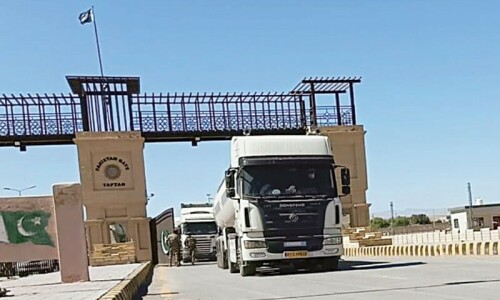
ISLAMABAD: In a significant move to curb the illegal entry of goods into the country, the government announced on Tuesday a 10 per cent processing fee on items imported under the Afghan transit trade agreement.
The decision — which aims to deter smuggling and ensure proper taxation — comes at a time when the government has ordered all illegal immigrants, including 1.73 million Afghan nationals, to leave the country or face expulsion.
According to the Customs Department notification (SRO1381 of 2023), the fee, calculated as 10pc ad valorem based on the original value of goods, must be paid in advance during the declaration process for Afghan transit commercial goods entering Afghanistan via Pakistan.
The items affected include confectioneries, chocolates, footwear, various machinery, blankets, home textiles, and garments.
10pc processing charges to be paid in advance at time of declaration for commercial goods imported via Pakistan
However, the notification stipulates that goods declarations filed before Oct 3 will not be subject to these new provisions.
Customs officials suspect that certain goods, though destined for Afghanistan, are clandestinely rerouted back into Pakistan, prompting this latest measure.
An official noted that cargo volume has surged recently. “Despite Afghanistan’s transit trade demand being $1bn to $2bn per year, we have observed a significant rise. This fee is expected to deter those involved in illicit trading,” the official said.
Under the transit trade agreement, Pakistan has the right to impose processing fees on cargo, the official said.
Pakistan has previously extended economic support to Afghanistan. Since the Taliban’s takeover of Kabul on Aug 15, 2021, Islamabad provided tax and duty exemptions on various commodities, including fruits and vegetables. Besides, from July 6 last year, the government also allowed the trade of all products via land routes to Kabul in rupees.
To combat smuggling, Customs has adopted several policies under the Customs Act, 1969. Essential commodities like wheat, flour, sugar and urea have been added to an essential commodities list to bolster the legal framework.
Besides, the Customs Act’s jurisdiction has been expanded to 10km from the original 5km near the borders with Afghanistan, India and Iran, and to 50km near specific Balochistan districts.
The government has also appointed the chief collector of customs (Balochistan) to address smuggling issues and liaise with law enforcement agencies.
Published in Dawn, October 4th, 2023