ISLAMABAD: The International Monetary Fund (IMF) on Wednesday forecast Pakistan’s fiscal deficit — the gap between the country’s total resources and expenditures — for the current financial year at 7.6 per cent of GDP, almost 1.1pc higher than 6.5pc target set by the federal government.
Even after taking into account Rs600bn cash surplus targeted by the Centre to come from provincial governments, the IMF estimate is about 0.6pc higher than the government’s budget target.
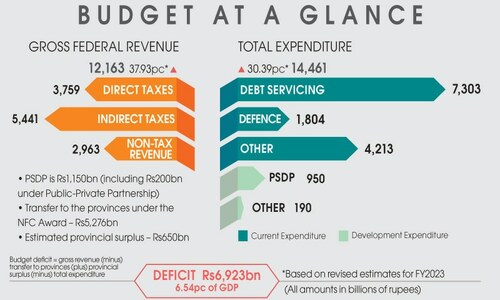
The centre had estimated the overall fiscal deficit for the current year at Rs6.9 trillion (6.5pc of GDP) on the anticipation that provinces would offer Rs600bn surplus to scale down federal deficit, otherwise estimated at Rs7.5tr, or 7.1pc of GDP.
As such, the IMF has stuck to its earlier projection made in July for the fiscal deficit on the basis of its agreement with then authorities as part of $3bn Standby Arrangement (SBA) for the nine months ending in March next year.
In its fiscal monitor, released on Wednesday as part of annual meetings of the IMF and the World Bank, currently in progress at Marrakesh, Morocco, the Fund forecast a decline in the fiscal deficit to 6.9pc of GDP in FY25, 5.4pc in FY26, 4.4pc in FY27 and 4.4pc by FY28.
This declining path is highly subject to changing economic and political conditions, both globally and at home, and on the premise that the next political government will maintain the pace of fiscal consolidation despite all odds.
Interestingly, both the IMF and the Pakistan authorities have a wide gap in their assessments of the primary deficit — the gap between revenues and expenditures, excluding interest payments — for the last fiscal year ending June 2023, but both have found the common ground about the primary balance for the current fiscal year.
The IMF in its fiscal monitor has pitched primary deficit for FY23 at 1.2pc of GDP compared to 0.5pc claimed by the government in the federal budget 2023-24. The IMF had put primary deficit for last fiscal at 1pc of GDP, which meant the data reconciled later may have seen slippages on both revenues and expenditures.
However, both the government and the IMF put the estimates for primary balance in current fiscal year at 0.4pc of GDP. The IMF also expects primary surplus to slightly go up to 0.5pc of GDP in FY25 and FY26 before declining again to 0.4pc of GDP in FY27 and FY28.
The Fund has slightly revised downward the general government revenues to 12.3pc of GDP for current fiscal year against 12.5pc it had estimated in July this year although it has kept unchanged its numbers for last two fiscal years, 12.1pc in FY2022 and 11.4pc of GDP in FY2023. Going forward, the fund expects revenues to stay at 12.4pc for FY25 and FY26 before declining to 12.3pc of GDP in FY27 and FY28.
On the other hand, the IMF revised total government expenditure data for FY23 upward to 19.5pc of GDP against its July 2023 estimate of 18.9pc of GDP, showing a gap of 0.6pc of GDP or about Rs450bn. Consequently, the IMF expects total expenditures to grow to 20.1pc of GDP (or about Rs21.3tr) during the current fiscal year against its July estimates of 19.8pc of GDP, reflecting a change of 0.3pc or Rs320bn.
For next fiscal year, the fund expects Pakistan’s expenditures to decrease to 19.2pc of GDP, followed by a downward trend to 17.8pc, 17.1pc and 16.7pc of GDP in FY26, FY27 and FY28, respectively.
The fiscal monitor put the gross government debt for FY23 at 76.6pc of GDP and forecast it to be down to 72.2pc of GDP during current fiscal year, followed by 70.4pc in FY25, 68.3pc in FY26 and ultimately reaching 64.1pc of GDP in FY28, still significantly higher than 60pc limit under the Fiscal Responsibility & Debt Limitation Act (FDRLA).\
Similarly, the net government debt for FY23 was put at 71.6pc of GDP, declining to 68.3pc during current year and gradually reaching 61.8pc of GDP by FY28.
The IMF found that Pakistan’s pension spending would increase by 0.2pc of GDP per annum between now and FY30, thus projecting the net present pension value increasing by almost 6.3pc of GDP from 2022 to 2050. Healthcare spending during the same period is projected to grow by 0.1pc of GDP, increasing by 5.3pc of GDP over the next 28 years.
The Fiscal Monitor 2023 observed that it has become hard for all countries to balance public finances. The difficulties originate in ever-growing demand for public spending, associated with high expectations about the state’s role, elevated debts, and high-for-long interest rates and political red lines on taxes.
But in most countries, tighter fiscal policies are needed, not only to reconstitute buffers and contain public finance risks, but also to contribute to central banks’ efforts in favour of a timely return to inflation targets, as debts are generally elevated around the world, and borrowing costs are rising.
Published in Dawn, October 12th, 2023