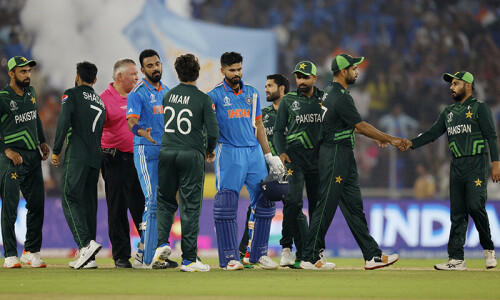
Analysis: Pakistan still have plenty to fight for after India loss


PAKISTAN crumbled in Ahmedabad in the face of a high quality all-round performance from India, who confirmed their status as tournament favourites. Rohit Sharma scored 86 runs in quick time to render Pakistan’s total meaningless.
A remarkable collapse, eight wickets for 36 runs, when Pakistan seemed well set, turned the game into a no contest. In a Pakistan-India match, to fail to compete is worse than losing. Worse still, it was a harsh reality check on Pakistan’s prospects in this World Cup.
India showcased the excellence of their bowling attack, but a stronger batting line-up than Pakistan’s would have increased the pressure on India. Instead, Pakistan let them off the hook and exposed their own flaws.
For thirty overs Pakistan looked serene, playing with an unexpected calm given the circumstances. The top four silenced the home crowd. A ripple of reluctant applause greeted Babar Azam’s half century, but it might have been mistaken for the fluttering of a hundred thousand handheld fans in the Gujarat heat.
Green Shirts’ approach may be fine for T20, but in either of longer forms it won’t deliver consistent success
Pakistan needed a big innings from one of their top order, who all got a start, but it didn’t come. Particularly disappointing was Babar’s failure to build on a fluent half century. Pakistan needed its middle order to build on a firm if meagre foundation, to navigate the fifty overs, but it collapsed horrifically.
The pitch was doing nothing except occasional low bounce. Little moved off the straight. It wasn’t a pitch that allowed carefree strokeplay, it lost pace and life as the ball grew old, but it wasn’t demonic. Nonetheless, Pakistan seemed to misread it, pushing for 300 when something above 250 might have sufficed.
And here is how Pakistan assisted their opponents. Abdullah Shafique played around a straight ball. Imam-ul-Haq opened his blade too much to a straight ball. Babar and Saud Shakeel just missed straight ones. The all-rounders were out of their depth and didn’t apply themselves. The innings was done, a bits and pieces effort.

It was hard to conclude that Pakistan crumbled under oppressive pressure. There wasn’t too much obvious intensity in the early part of Pakistan’s innings. Saud looked unusually nervous and some of the lower order lost their heads, but the gap wasn’t one of mentality, it was one of quality, a lack of specialism.
The truth staring into the face of Pakistan cricket, and it is one that has been peering in for over a decade or more, is that India produces high quality batsmen, performing at the top end of international cricket. It produces high quality spinners.
Pakistan, by contrast, struggles to field six batsmen capable of dominating in international cricket. When it comes to batting, Pakistan rely on Babar and Mohammad Rizwan, they occasionally muddle through with a one off effort from another player, or the bowlers get them out of a hole.
It’s an approach you can get away with in T20 cricket, but in either of the longer forms it won’t deliver consistent or long-term success. This is an area of urgent focus after this World Cup.
Depth of batting order
The other issue apart from the general quality of Pakistan’s batsmen is the depth of the batting order. Yes, the lower middle order can contribute but the best teams have players capable of a major innings lurking down the order. Pakistan don’t have such players with their crop of all-rounders.
The limitations of those same all-rounders were exposed when they were asked to defend a small total. Again, a quality gap was evident in Pakistan’s support bowlers, especially the spinners. Where is the successor to Saqlain Mushtaq and Saeed Ajmal? Pakistan needs specialists not jacks of all trades.
None of this means that Pakistan don’t have enough to venture deep into this tournament but, at present, it seems a long shot that they can mount a serious challenge.
To do so, they will need to bat smarter around their top players because small totals won’t be defendable. They will require the individual brilliance of their top batsmen to become consistent brilliance. And they will need more penetration from their bowlers, particularly Shaheen Shah Afridi who seems to have lost his zip.
This is a tall order although not impossible. A regulation defeat in Ahmedabad and Pakistan would have shrugged their shoulders and moved on. Instead, Pakistan will require a psychological reboot, a performance to make them believe in themselves again.
The manner of the defeat and the flaws it has brought into full view, when pitted against the quality of their fiercest rivals, will be hard to recover from, but these are early days and Pakistan have plenty of opportunity to make critics eat their words and they still have plenty to fight for.
Published in Dawn, October 15th, 2023