Stakeholders make case for carbon trading
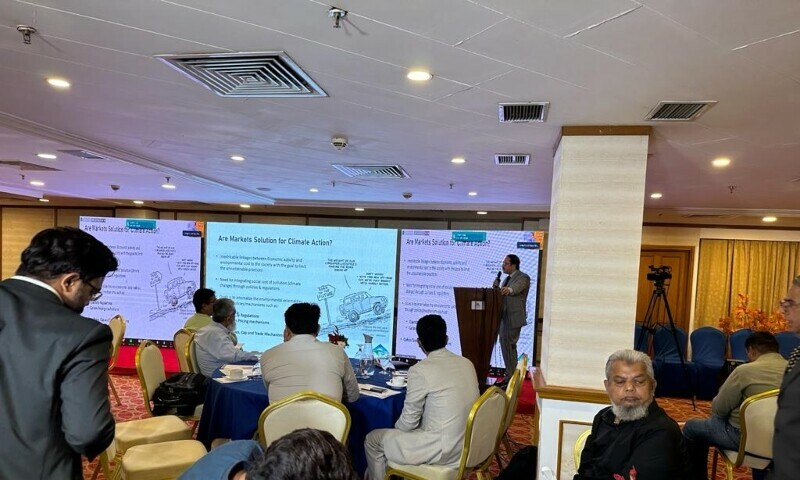

KARACHI: Pakistan has substantial potential for emission reductions in energy, transport, industry and agriculture, which makes its marginal abatement cost “considerably lower” than that of many other countries.
Speaking at a seminar on Tuesday about “Leveraging carbon markets to enable private investment,” National Disaster Risk Management Fund CEO Bilal Anwar said stakeholders should identify potential sectors for carbon trading.
Pakistan has committed to reducing 50 per cent of its overall projected emissions by 2030, a task that requires heavy financing. “Article 6.4 can translate the financing through transactions of untapped emission reductions,” he said while referring to a part of the Paris Agreement that provides a structure for a carbon credit market through which greenhouse gas (GHG) emission reductions — or removals — can be transferred internationally.
“Pakistan needs to set up institutional and procedural frameworks,” he added.
In a world that’s becoming increasingly aware of the effects of climate change, governments around the world have been using different carbon pricing mechanisms to limit CO2 emissions. These mechanisms include carbon tax, emissions trading system, carbon offsetting, results-based climate finance and internal carbon pricing.
Carbon markets are either voluntary carbon markets (VCMs) or compliance carbon markets (CCMs). The first category consists of decentralised markets where private actors voluntarily buy and sell carbon credits that represent certified removals or reductions of GHGs. In contrast, CCMs are governed by “cap-and-trade” regulations where carbon emission certificates for domestic firms and sectors are issued by government organisations or international bodies like the United Nations.
Thus, a carbon credit works as a financial instrument equivalent to either the right to emit one metric tonne of CO2 (an allowance) or the reduction of one metric tonne of CO2 (i.e. an offset). Participants in a carbon market are then allowed to trade emission reduction permits to make profits from unused allowances.
A number of national carbon markets have emerged in different parts of the world in view of the internationally agreed timeline to hit net-zero GHG emissions by 2050. The Chinese carbon market is the largest in the world in terms of GHG emissions covered. “Pakistan can benefit by interlinking with the Chinese carbon market,” said Mr Anwar.
Around 20pc of global GHG emissions are currently covered by a direct carbon price or some carbon pricing mechanism. “With the Paris Agreement becoming effective and demand for global carbon credits increasing, the price of carbon credits has shown a growing trend and is likely to increase in the future,” he added.
As for the corporate sector in Pakistan, Mr Anwar said 24 companies have voluntarily pledged to become net zero by either 2030 or 2050.
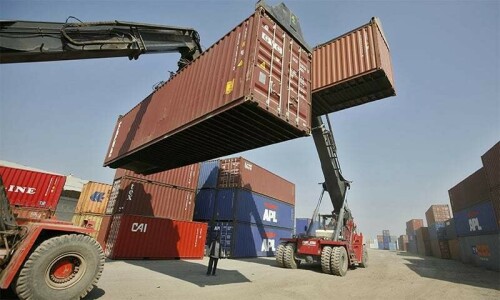
He said export-oriented companies will have to comply with a range of international standards like the Carbon Border Adjustment Mechanism (CBAM), which is a new set of trade rules that imposes carbon fees on all imports into the European Union from non-members like Pakistan.
The country’s energy sector alone offers a substantial potential for GHG emission reductions because it holds a share of nearly 40pc in the total emissions, he said.
Representatives from the private sector, public sector, UN agencies, environmental organisations and climate change activists participated in the seminar.
Published in Dawn, October 25th, 2023