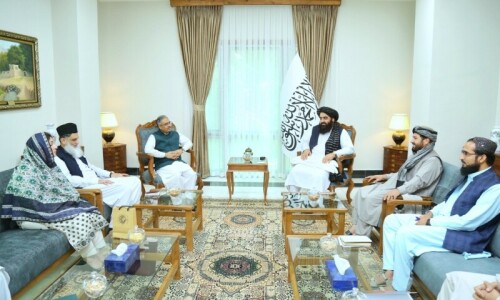
CARETAKER PM Anwaar-ul-Haq Kakar’s no-holds-barred criticism of the Afghan Taliban during a presser on Wednesday reflects the state’s disappointment with Kabul’s current rulers.
The PM basically held the Afghan Taliban responsible for the banned TTP’s murderous assaults inside Pakistan, as according to him the former had failed to stop the latter’s terrorist attacks — originating in Afghanistan — directed at this country.
What makes this realisation even more agonising is that there was a time when those who call the shots in Pakistan considered the Taliban ‘our boys’ in Kabul. Mr Kakar laid out a damning charge sheet, pointing out that after the Taliban took Kabul in 2021, there was a “60pc” increase in terrorism and a “500pc” spike in suicide attacks, resulting in 2,867 fatalities.
This, Mr Kakar observed, was so despite the fact that “we” had high hopes that anti-Pakistan groups would be handled by the Taliban after their victory. But that was not to be.
The Afghan conundrum in fact represents the repeated failures of Pakistan’s security and foreign policies, specifically of seeking ‘strategic depth’ in our western neighbour.
Pakistan helped the US and the Saudis bring down Kabul’s communist regime during the Afghan jihad, while ties with the US-backed regimes post-9/11 were lukewarm, if not outright hostile.
True, Pakistan alone is not to blame, but the state should realise the mistakes made by previous administrations, and not repeat them. When the Taliban took over, Pakistan was supposed to have reliable friends in Kabul. But perhaps the state has failed to properly understand the Taliban psyche.
After all, during the US occupation, much of the Afghan Taliban leadership took refuge in Pakistan, as ‘guests’ of the forces that would later coalesce into the TTP. Bound by Pakhtunwali and religious codes, did our planners really expect the Taliban to expel their former comrades-in-arms once they took Kabul?
It should be remembered that the previous Taliban regime let their administration fall rather than give up Osama bin Laden to the West. Moreover, aside from the differing perspectives on militancy, the hasty decision to expel Afghan nationals has also rubbed the Taliban the wrong way.
The Afghan Taliban may be difficult customers to work with, but Pakistan has little choice as there is no one else to call in Kabul. Instead of ratcheting up the rhetoric, Pakistan should keep the channels of communication open.
The message mustn’t be antagonistic but should be firm: stop the TTP and other anti-Pakistan terrorists from attacking this country. There can be no compromise on this.
Pakistan should also continue to work with other regional states so that this anti-militancy messaging is clearly communicated to Kabul. If relations worsen with Afghanistan, only the TTP, IS-K and other bloodthirsty outfits will benefit.
Published in Dawn, November 10th, 2023