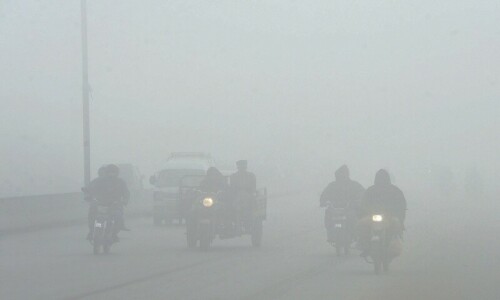
LAHORE: After a brief respite, Lahore finds itself engulfed once again in a haze of hazardous air, with the air quality index (AQI) reaching alarming levels on Tuesday.
The city, which had enjoyed five days of relatively normal air quality, experienced a sudden spike with a maximum AQI of 401 recorded at 9am, marking it as extremely unsafe for breathing.
According to data from the global air quality monitoring platform, iqair.com, the situation slightly improved in the afternoon, with the AQI dropping to 188 by 7pm. However, hopes for a sustained improvement were dashed as the air quality deteriorated again, registering an AQI of 236 at 9pm. This unsettling development catapulted Lahore to the third spot on the list of the most polluted cities globally.
It’s crucial to highlight that an AQI below 50 is considered safe for breathing, and Lahore’s current readings indicate a severe threat to public health.
AQI in different areas of the city ranged from 231 to 401
The air quality across different areas of the city varied significantly. Fida Hussain House reported an AQI of 364, Syed Maratib Ali Road at 309, CERP Office at 282, Polo Ground Cantt at 270, US Consulate in Lahore at 270, Lahore American School at 267, NetSol LHR2 at 259, Pakistan Engineering Services (Pvt) Ltd at 240, DHA Phase 8 at 236, and WWF Pakistan at 231.
Lahore traditionally experiences a decline in air quality during the winter season, particularly from October to February. During this period, farmers in the wider Punjab province burn crop remnants, contributing to the smog. Weather changes further exacerbate the problem by trapping pollutants in the air for longer duration.
The primary contributors to air pollution in Lahore include vehicle and industrial emissions, smoke from brick kilns, burning of crop residue and general waste, and dust from construction sites. Deforestation for infrastructure development, such as new roads and buildings, also plays a significant role.
The winter air pollution is worsened by temperature inversion, a phenomenon where a layer of warm air prevents the upward movement of pollutants, leading to their accumulation.
To combat the rising air pollution crisis, experts suggest that real-time air quality data should be made readily available to the public with greater granularity.
When individuals are aware of the pollution levels they are exposed to, they can take informed measures to protect themselves and contribute to collective efforts in combating air pollution.
Reducing industrial and vehicular emissions is identified as a critical step towards improving air quality. As the situation in Lahore continues to worsen, urgent and coordinated efforts are required to address the root causes of air pollution and safeguard the health and well-being of the city’s residents.
Published in Dawn, November 15th, 2023