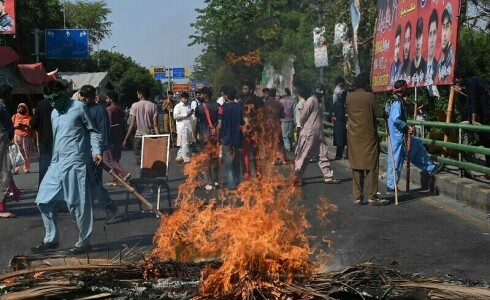
The caretaker federal government filed an appeal in the Supreme Court on Friday against the decision of a five-member bench that had declared the trials of civilians under the Pakistan Army Act 1952 as unconstitutional.
Former chief justice Jawwad S. Khawaja, one of those who successfully petitioned the Supreme Court against the military trials of civilians, the provinces of Balochistan, Sindh, Khyber Pakhtunkhwa and Punjab, through their respective chief secretaries; and the government, through the secretary of the defence ministry, were named respondents in the case.
In the widely praised Oct 23 ruling, the bench, comprising Justices Ijazul Ahsan, Munib Akhtar, Yahya Afridi, Syed Mazahar Ali Akbar Naqvi and Ayesha Malik had declared that trying civilians in military courts for their alleged role in attacks on army installations during the riots that followed PTI chairman Imran Khan’s arrest were ultra vires the Constitution. The bench had also emphasised that the cases of the suspects involved in the vandalism would proceed before criminal courts.
The federal government’s appeal comes on the heels of a similar plea filed by the Sindh government. The fresh appeal has not yet been accepted for hearing.
The appeal filed by the Centre, a copy of which is available with Dawn.com, that the incidents of May 9 involved “targeted attacks” on military installations and establishments in an “organised and coordinated manner”, adding that they were “neither localised nor isolated”.
The plea said that several first information reports (FIRs) were registered in the aftermath. It noted that several of the FIRs did not mention provisions of the Army Act but argued that the SC had previously held that the contents and not a particular statutory provision determined the nature of offences.
It said that the Supreme Court Practice and Procedure Act was declared ultra vires the Constitution and had taken effect since April 21. “In view of the Act having attained constitutional validity, it is submitted with reverence that the constitution of the bench […] is in contravention to the procedure prescribed under Section 2 and 3 of this Act,” it said.
“Therefore, the judgement is liable to be set aside for having been rendered coram non judice [without jurisdiction] and thus a nullity in the eye of law,” the appeal said. It further said that the petitions were not maintainable before the top court in its original jurisidcition under Article 184(3).
It said that the challenges raised in the petitions could have been adjudicated by the high courts in their original constitutional jurisdiction under Article 199. The appeal argued that the petitions fell outside the purview of “the contours that this court had determined for the exercise of its original jurisdiction”.
The appeal said that the trial of accused persons, whether military personnel or otherwise, could not be challenged for being in violation of any of the fundamental rights enshrined in Articles 9, 10-A and 25.
It said that offences under Section 2(1)(d)(ii) included those offences under the Official Secrets Act which “related to works of defence or naval, military or air force affairs, which may be prejudicial safety, interest, defence, sovereignty, and sanctity of Pakistan […]”.
“It is clear from the nature of these offences that despite being committed by person who are not members of the armed forces, they are closely related to the proper discharge of duties of such members,” the appeal said.
It contended that Sections 2(1)(d) and 59(4) of the Army Act were “constitutionally insulated from a challenge on the touchstone of fundamental rights and the impugned order/judgement, to the extent that it has failed to appreciate this, has erred in law. Therefore, on this count, the impugned order/judgement is liable to be set aside,” it said.
The appeal said that the judgement, to the extent of finding the provisions of the Army Act unconstitutional on account of Article 175(3) and the requirement therein of separation of judiciary from the executive, was “untenable, contrary to settled jurisprudence of this honourable court and thus, liable to be set aside”.
“It is therefore humbly prayed that this honourable court may be pleased to allow this appeal, set aside the impugned order/judgement […] and dismiss the petition with costs. Pending the decision on the appeal, the operation of the impugned order/judgement may graciously be suspended,” the appeal said.