Trans community raises demand for identity at Moorat March
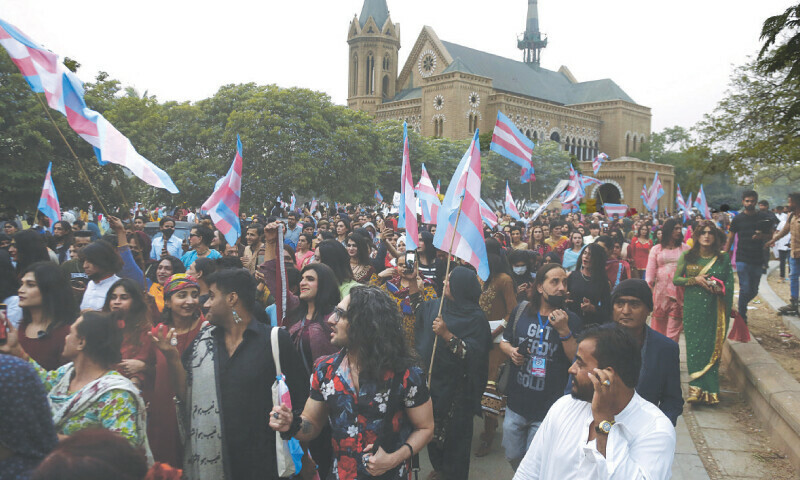

KARACHI: The second Sindh Moorat March brought many transgender people — sporting the colour red and waving light blue, pink and white striped transgender flags of pride, from the city and all over the province, including Sukkur, Larkana and Hyderabad — to the Frere Hall lawns here on Sunday.
According to transgender Shahzadi Rai, who works as a councillor with the Karachi Metropolitan Corporation, they decided to have a red theme deliberately. “It is a vibrant colour, which is associated with revolution, love and happiness.”
The first Moorat March was held at the same place and at around the same time last year.
As explained at the event, the second march had to be held as many of the demands raised the first time are still not met.
The programme commenced after observing two minutes of silence in support of people of Palestine.
Human rights activist and legal expert Sara Malkani educated about the Transgender Protection Act, a law with provision to recognise the third gender, their needs and rights, which was passed by the Parliament in 2018, and which then was seen as having contradictions with Islam by the Federal Shariat Court after the petitioning of a politician followed by a campaign also generated by him.
“But it is against the Constitution of Pakistan to not consider the rights of people,” she said.
“The khawaja sira community need their identity. They know who they are and they don’t need a medical board to determine their gender,” she added, referring to the actions taken after the Shariat Court’s ruling, which also included the X gender category removed from CNICs and involving a medical board to first determine the gender of anyone asking for an X gender card among other things.
Chairperson of the Sindh Human Rights Commission (SHRC) Iqbal Detho also said that when transgender people spoke about their right to an identity and their rights, they were laughed at.
“They are taken as a joke and face harassment. But they are also human beings, they have human rights,” he said.
“It is sad that our courts saw a selective interpretation of their rights. We need to speak more and educate people about the third gender and their right to an identity. Sadly, they were also facing a problem of not being issued CNICs in Sindh but SHRC has intervened to resume those at least. It will give this community the right to vote,” he said.
Shahzadi also brought her boss, the Mayor of Karachi barrister Murtaza Wahab to the march. “My presence at this march today is a proof that the Pakistan Peoples Party is all for giving equal chances to all communities,” said the mayor.
“We want to end all discrimination in society. My party and your Shahzadi Rai are working towards this goal. We made an amendment to our laws to include your community in politics and elections,” he added.
Those who spoke and performed at the march included transgender persons Sana Khan, Alisha and Maryam Sheikh from Hyderabad, Sanam Faqir from Sukkur, Canadian-Pakistani transgender musician Urvah Khan, transgender activist and medical doctor Dr Mehrub Moiz Awan, male transgender Rehan Muddasir, transgender Naseebo Jan of the Women Democratic Front and executive director of Gender Interactive Alliance, Bindiya Rana, also known as Maadar-i-khawaja sira.
They raised 12 key demands, including criminalising all forms of hate speech based on gender identity, not dismissing murders of transgender people through Qisas and Diyat, addressing the housing crisis faced by transgender community, incorporating designated seating for transgender people in public transport and enforcing the 0.2 per cent employment quota for them.
More demands included designing a transgender-specific HIV programme, revising the educational curriculum to encompass the profound political and cultural history of khawaja siras in South Asia, ensuring that they are not denied their lawful rights to assets and inheritance, officially recognising them as a protected indigenous population and a ban on unnecessary surgeries on intersex children without informed consent.
Published in Dawn, November 20th, 2023