Indian SC to announce verdict on removal of occupied Kashmir’s special status on Dec 11


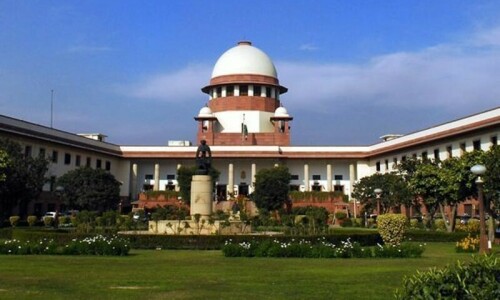
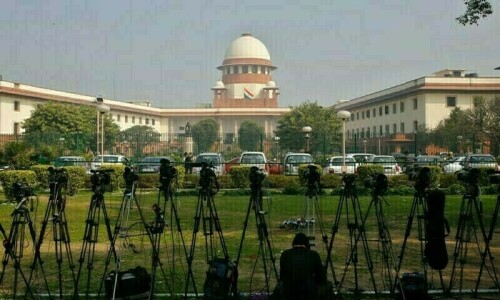
India’s Supreme Court will pronounce its verdict on a set of pleas against New Delhi’s 2019 imposition of direct rule in occupied Kashmir on Dec 11 (Monday), The Times of India reported on Friday.
In 2019, India’s ruling Bharatiya Janata Party (BJP) had revoked occupied Kashmir’s special status by repealing Article 370 of the constitution.
Article 370 had limited the power of the Indian parliament to impose laws in the state, apart from matters of defence, foreign affairs and communications.
The move allowed people from the rest of the country to have the right to acquire property in occupied Kashmir and settle there permanently.
Kashmiris, international organisations and critics of India’s Hindu nationalist-led government had termed the move an attempt to dilute the demographics of Muslim-majority Kashmir with Hindu settlers.
A five-member bench headed by Chief Justice of India (CJI) D.Y. Chandrachud had begun hearing the set of petitions on July 11 and reserved its verdict on September 5.
According to India Today, the petitioners included leaders of the National Conference and the People’s Democratic Party (PDP).
The bench — also including Justices Sanjay Kishan Kaul, Sanjiv Khanna, B. R. Gavai and Surya Kant — is to decide if the move was legal despite lacking the endorsement from parliament usually required for constitutional change.
During the proceedings, the PDP had told the court that then-governor Satya Pal Malik was not consulted before the decision was taken by the central government to abrogate Article 370, India Today stated.
Meanwhile, the centre had argued in support of its step and claimed there was no “constitutional fraud” in annulling the provision, the report added.
Senior counsel Kapil Sibal had contended that the concurrence of the state government provided by the governor did not express the will of the people.
The apex court had asked the BJP-ruled central government whether there was a timeline to convert Indian-held Kashmir from a union territory to a state.
Pakistan and India have fought three wars over control of the region and thousands have been killed in a freedom movement against Indian rule in the Muslim-majority territory since 1989.
The suspension of occupied Kashmir’s semi-autonomous status allowed Indians from elsewhere to buy land and claim government jobs there, a policy denounced by critics as “settler colonialism”.
Many residents and critics say that authorities have since curbed media freedoms and public protests in a drastic curtailment of civil liberties.
Indian Prime Minister Narendra Modi’s government has defended the decision in the court, saying the change had brought “peace, progress and prosperity” to the restive territory.
Consolidating New Delhi’s rule over its portion of the territory has long been a key plank of Modi’s Hindu nationalist BJP.
The frequency of armed clashes between Indian soldiers and freedom fighters has dropped significantly in recent years as India works to fortify its rule over the territory.