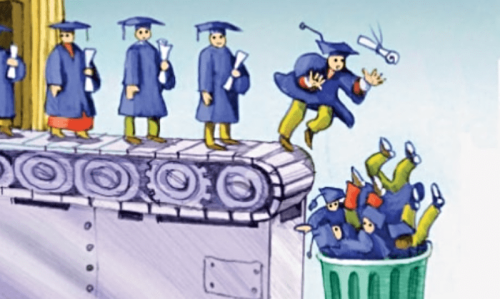
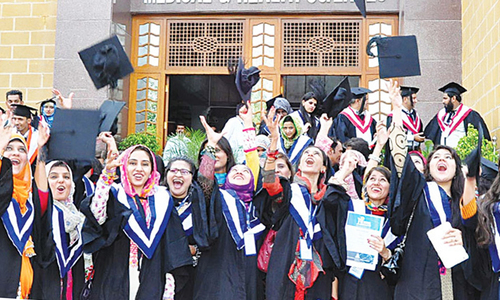
A COLLEGE or university degree — preferably the highest possible — is sometimes indispensable. Anyone treated by a degreeless cardiologist or neurosurgeon is either stupid or reckless. Flying in a plane designed by engineers who failed their math-physics qualifying exams puts your life at risk. High-level formal education will remain valuable both tomorrow and into the foreseeable future.
But the topsy-turvy hi-tech world up ahead presents us with a paradox. AI is already displacing humans from many jobs. Setting aside Pakistan for later discussion, demand for college and university education — particularly in less than top-level technical fields — is already plummeting downwards. Key captains of global industry are openly sceptical about formal degree programmes.
Elon Musk, CEO of Tesla and SpaceX, places specific skills and problem-solving abilities above theoretical knowledge. He says that “college is basically for fun and to prove you can do your chores, but doesn’t necessarily teach you what to do in the real world”.
Peter Thiel, co-founder of PayPal, is famously offering $100,000 fellowships encouraging young people to drop out of universities and start their own businesses. Thiel accuses American higher education of stifling creativity and independent thinking, and also claims that real-world experience is more valuable than education.
Pakistani degrees will soon become trash in the global marketplace for jobs but there is a way out.
These two American capitalists are mavericks known for extreme views. One is tempted to discount them as victims of the high pressure and chronic feverishness endemic to Silicon Valley. Nevertheless, others far away are also saying such things and so one must pay at least some attention.
More and more employers in advanced countries — and now even India — are looking mostly for skills, learning agility, work ethic, and creativity. Companies like Apple and Tesla no longer require a college degree for an interview. Most have devised their own tests for assessing a candidate.
One must not, however, rush to conclusions. Behind today’s high technology is the core knowledge transmitted and produced in a million university classrooms and laboratories around the world. High-class universities have historically been the engines of social change, founts of new ideas, and concentrations of high brain power. Musk and his arrogant ilk would be nothing without that.
Turning now towards Pakistani universities, let’s look at the present and future worth of their degrees and graduates.
Research in these institutions exists only in name. Over the last 20 years, they have produced tons of so-called research papers and theses but not a single significant piece of new knowledge, invention, process, or patent that achieved commercialisation.
What about the value added in terms of instruction, knowledge transmission, and skill addition? Take engineering. Even top Pakistani universities produce graduates whose careers generally start — and end — in maintenance, sales, and management. Almost none do what’s expected of real engineers, ie, conceptualise and design new technologies or make radical improvisations. Exceptions aside, the inferior mathematical,analytical and problem-solving skills of our graduates cannot handle unmet needs and challenges.
Here’s a recent example. Some weeks ago The Black Hole, a science-centred organisation in Islamabad, initiated a stipend-incentivised high school math-physics teachers training programme. A total of 120 applicants from ages 20-32 took the entrance test. Candidates variously had BSc, BS, MSc and MPhil degrees from institutions in several cities.
Although test questions were set at 12th grade school level or lower, they did test reasoning capacity. Sadly, just 27 of the 120 graduates scored over 50 per cent. Those holding higher degrees did no better than the ones with lower degrees showing that real learning stops early on. When we interviewed the top 27 to check for conceptual clarity, only six could survive. Their superior performance manifestly owed to self-study, not to the institutions they had studied in.
Notwithstanding poor teaching quality, degrees from Pakistan’s junk universities — which means practically all of them — will remain in demand. We all know the reason. A degree in the Pakistani context is basically a required rubber stamp after which family connections, religious and ethnic affiliation, and personal friendships determine who gets a job. Competence and ability are secondary.
In contrast, the global job marketplace wants real knowledge and skills. Wealthy parents understand this and try to send their children to universities abroad but the sinking rupee is making this more difficult. Plus the shrinking job value of overseas degrees will shrink further. What little overseas worth a Pakistani degree presently has will soon disappear entirely.
So, what is the way out? For a brighter future, what path should your child follow?
Asked a similar question in the Indian context, Narayana Murthy, founder of the $100 billion company InfoSys, responded without hesitation. What’s needed, he said, is “to plant a seed in the minds of the primary and secondary school children the need for independent thinking, active listening, critical thinking, Socratic questioning, and relating what is learnt in the classroom to the problems around us”.
Murthy is spot on. Think of it this way: your computer must first be booted, meaning it must first be loaded with the right instructions for the operating system (Windows or Mac) to start working. After the computer has learned how to learn — but not before that — the chips inside are activated.
For children, their brain circuits need similar activation. Once booted, the neuronal machinery inside can access the vast stores of knowledge in cyberspace.
Countless internet modules, whether for purchase or free, teach you step-by-step whatever subject or skill you want to learn. Your desire, and capacity to absorb, sets the only limits. Never before has it been so easy for an individual to rise to the sky starting from ground up.
The magical principle for success is only one: successfully learning how to learn. For this the child’s mind must first be set free to explore and think. But in cultures where the primary goal of education is to hammer in an ideology, this is impermissible.
A religion-based curriculum inevitably rewards passivity and unquestioning acceptance. At best it turns out drones. Unfortunately for Pakistan, its Single National Curriculum guarantees that the future of our youth will become increasingly dimmer, not brighter. Their only chance lies in self-learning.
The writer is an Islamabad-based physicist and writer.
Published in Dawn, December 9th, 2023