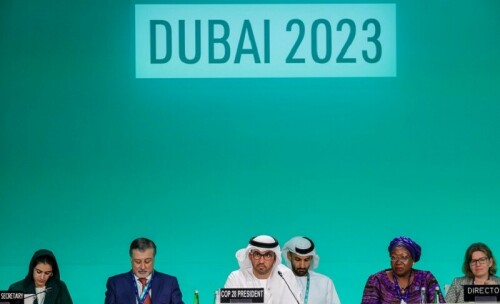
DUBAI: A draft of a potential climate deal at the COP28 summit on Monday suggested a range of options that countries could take to reduce greenhouse gas emissions, but omitted the “phase out” of fossil fuels that many nations have demanded.
COP28 President Sultan Al Jaber urged the nearly 200 countries at the talks to redouble their efforts to finalize a deal ahead of the scheduled close of the conference on Tuesday, saying they “still have a lot to do”.
The new draft of a COP28 agreement, published by the United Arab Emirates’ presidency of the summit, proposed various options but did not refer to a “phase out” of all fossil fuels, which had been included in a previous draft. Instead it listed eight options that countries “could” use to cut emissions, including: “reducing both consumption and production of fossil fuels, in a just, orderly and equitable manner so as to achieve net zero by, before, or around 2050”.
Other actions listed included tripling renewable energy capacity by 2030, “rapidly phasing down unabated coal” and scaling up technologies including those to capture CO2 emissions to keep them from the atmosphere.
US, EU, Germany and France irked by watered-down text
A coalition of over 100 countries including big oil and gas producers the United States, Canada and Norway, as well as the European Union and island nations, wanted an agreement that included language to phase out fossil fuels.
A US State Department spokesperson said the draft deal text needs to be strengthened.
The European Union’s climate chief, Wopke Hoekstra, told reporters that the text contains elements that “we simply cannot accept.” The proposal is “clearly insufficient and not adequate to addressing the problem we are here to address.”
“A central aspect, in my opinion, of the success of the COP will be for the COP to reach a consensus on the need to phase out fossil fuels,” UN Secretary-General Antonio Guterres said on Monday.
Germany’s foreign minister Annalena Baerbock said that the draft deal was clearly insufficient and disappointing, and that as replacing fossil fuels was completely absent from the draft deal, Germany could not support it.
France’s minister of energy transition, Agnes Pannier-Runacher, also called for change on the fossil-fuel language.
“This text is insufficient. There are elements that are not acceptable as they are. It’s a disappointment,” she said.
But not all Arab nations backed the Saudi-led bloc’s obstinate stance. While Riyadh, the world’s top crude exporter, didn’t want fossil fuels mentioned at all in a draft text at the UN talks, the Emirati president of COP28, Sultan Al Jaber, urged an historic accord that addresses the fate of oil, coal and gas.
For other states in the Middle East that don’t have oil riches, lining up with the Saudis clashes with their own environmental, agricultural and health interests, NGOs say.
“We’re seeing a split between the UAE and other big petrostates on the future of fossil fuels,” said Jim Krane of Rice University in Texas. “For the Saudis, despite living in one of the most heat-stressed places on Earth, saving oil is more important than saving the climate,” Krane said.
Published in Dawn, December 12th, 2023