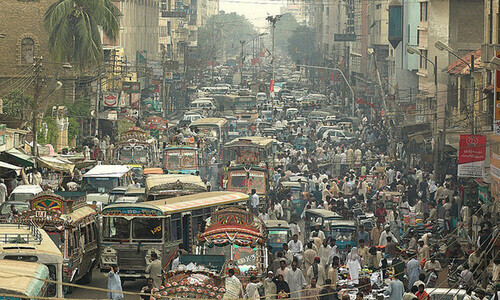
ACCORDING to Pakistan’s 2023 census, our country’s population has officially surpassed the 240 million mark — an increase of 33.8m people since the previous census in 2017. The growth rate jumped from 2.4 per cent in 2017 to 2.55pc in 2023, which is a worrying reversal of what was an otherwise downward trend.
Over two decades ago, Pakistan committed to reaching replacement-level population growth rates (2.1pc) by 2020. However, the recent census figures indicate that we are even further from reaching this goal than we were six years ago; this is a clear indication of decades of failed policies and a lack of commitment on the part of the government to reaching this goal.
If we continue at this rate, Pakistan will move from being the sixth most populous country in the world to the fifth — a race we do not want to be winning. For anyone concerned about the well-being of those living in this country, particularly the well-being of its women, this should be serious cause for concern.
Pakistan’s population growth rate stands in stark contrast to other countries in our region. India’s growth rate in 2023 was 1.10pc, Nepal’s 1.25pc, Bangladesh 1.26pc, and Sri Lanka a mere 0.83pc.
While economically advanced countries, such as Japan and South Korea, are worrying about an aging population, for developing countries like our own, such a high growth rate is unsustainable and will inevitably lead to a host of environmental and social problems.
One consequence that we are currently facing is the increasing youth bulge, with millions of frustrated young women and men who are unable to be absorbed into the economy.
Women’s rights should be at the centre of the political agenda.
High population growth is a symptom of poverty and a lack of human development in general. Hence, the most underdeveloped province, Balochistan, also has the highest growth rate in the country (3.2pc). Consequently, Balochistan also has the highest maternal mortality rate of any of the provinces (298 per 100,000 births), which is by far the highest in the region.
Persistent poverty is one of the major factors behind the high growth rate. Contrary to the popular belief that poor people have more children because they are ignorant, having more kids for those lacking productive assets is actually a very rational decision.
The more children one has, the more people there are to contribute to the family income. If the cost of having a child outweighs the benefits in terms of income, then families are likely to have fewer children. But this is only a small part of the story.
Many women end up having more children not because they want to but simply because they do not have access to contraceptive methods or control over their health-related decision-making. Despite decades of population planning and technological advances in reproductive health, according to the UNFPA, 5.5m women in Pakistan had an unmet need for contraceptives in 2020 resulting in millions of unwanted pregnancies.
For this reason, Pakistan also has one of the highest abortions rates in the world — 50 per 1,000 pregnancies according to a study published by the Population Council in 2012. It can be assumed that this number has only increased given the current rise in the population growth rate overall.
Most of these abortions are conducted under the table by untrained providers, often resulting in the death of the mother, thus contributing to higher maternal mortality rates overall. Countless women die silently every year due to unsafe abortions. This is a tragedy that could easily be averted if only there was political will.
High population growth rates are both a cause and a consequence of gender inequality. Despite Pakistan committing to meeting SDG-5, the achievement of gender equality and the empowerment of women and girls, little concrete action has been taken.
In 2023, Pakistan ranked 142 out of 146 in the Global Gender Inequality Index. Low rates of female education, labour force participation, early marriages, a lack of decision-making power within the household, and a lack of access to healthcare (including contraceptives) all contribute to higher birth rates.
According to the Pakistan Demographic and Health Survey (2017-2018), only 7pc of currently married women of reproductive age were able to make decisions regarding their contraceptive use. Rather than treating women as fully productive members of society, they are too often treated as vessels to produce more children, whether they like it or not.
Large family sizes with inadequate spacing are harmful to women’s physical and mental health and hinder their full economic, social and political participation. Furthermore, discrimination against women and girls also leads to the practice of son preference; many families have more children in the hopes of producing more sons. It is a vicious cycle.
Until and unless gender equality is placed at the centre of the political agenda, and women and girls are valued for their full human potential, our population growth rates are unlikely to decrease. And until and unless the population growth rate starts to decline, the achievement of gender equality in Pakistan will remain a distant dream.
Even though it is women who bear the burden of childbearing and child-rearing, and despite the heaps of research pointing to the connection between women’s empowerment and lower fertility rates, discussions of population planning, if they happen at all, rarely make any mention of women’s rights. Rather, the focus is generally on ‘family planning’, which involves meeting blunt targets with regards to contraception.
While even this would be a welcome step given the government’s poor track record over the past decades, a holistic approach focused on poverty reduction, equitable development, and most importantly, treating women not as targets for family planning but as full human beings is urgently required to bring the population growth rate down to sustainable levels.
The writer is associate professor of sociology at Lums.
Published in Dawn, December 23rd, 2023