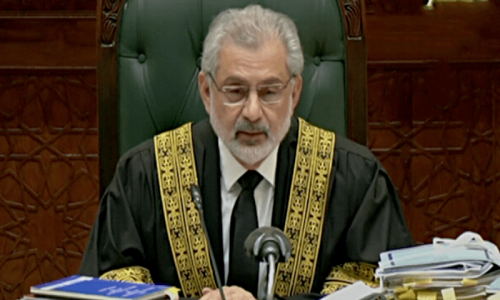
With the upcoming general elections around the corner, a seven-member bench of the Supreme Court will take up the issue of lifetime disqualification tomorrow (January 2).
Headed by Chief Justice of Pakistan (CJP) Qazi Faez Isa, the bench comprises Justice Syed Mansoor Ali Shah, Justice Yahya Afridi, Justice Aminuddin Khan, Justice Jamal Khan Mandokhail, Justice Muhammad Ali Mazhar and Justice Musarrat Hilali.
It was constituted by a three-judge committee — comprising the CJP, Justice Sardar Tariq Masood and Justice Ijazul Ahsan — under the Supreme Court (Practice and Procedure) Act 2023.
The bench will determine once and for all the raging debate on whether aspirants disqualified under Article 62(1)(f) of the Constitution could contest polls in light of the amendments in the Elections Act 2017.
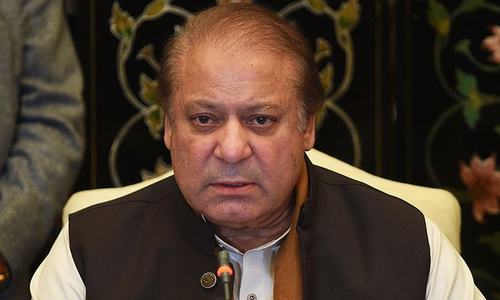
The law, which sets the precondition for a member of parliament to be “sadiq and ameen” (honest and righteous), is the same provision under which former prime minister Nawaz Sharif was disqualified in the Panama Papers case. Imran Khan was also disqualified under the same article in the Toshakhana case last year.
The legal dilemma arose in view of a 2018 Supreme Court judgement when it shut the doors of parliament permanently for politicians disqualified under Article 62(1)(f) of the Constitution through a unanimous verdict, ruling that such ineligibility was for life.
The verdict was issued by former chief justice Mian Saqib Nisar, Justice Sh. Azmat Saeed, ex-CJP Umar Ata Bandial, Justice Ahsan and Justice Sajjad Ali Shah.
But on June 26, 2023, an amendment was brought in the Elections Act 2017, specifying that the period of the electoral disqualification will be for five years, not for life.
The issue of electoral disqualification cropped up in the apex court again last month during the hearing of a petition moved by Sardar Mir Badshah Khan Qaisarani, who had filed nomination papers from constituency NA-189 and PP-240 Taunsa (Dera Ghazi Khan) in 2008 and 2018 elections, respectively. He was disqualified for producing a fake graduation degree. His appeal is still pending before the Lahore High Court.
CJP Isa had subsequently referred the matter to the three-judge committee responsible for forming benches. The court had also ordered the publication of a public notice so that anyone or political parties become party if they wished.
During the hearing, the top judge had remarked that the SC verdict on lifetime disqualification and the amendments made to the Elections Act, 2017 could not co-exist. He had further stated that discrepancies in the SC’s interpretation and the law could result in “confusion” in the upcoming general elections.
At the same time, the court had also clarified that the pendency of the present case should not be used as a tool or a pretext to delay the elections, neither by the Election Commission of Pakistan nor any other entity.