Will the election be held on Feb 8?


LAHORE: As the Pakistan Tehreek-i-Insaf (PTI) faced a setback after the decision of the Supreme Court and there is still uncertainty about the upcoming election, a session at the Afkar-e-Taza ThinkFest discussed the political situation in the country on Sunday.
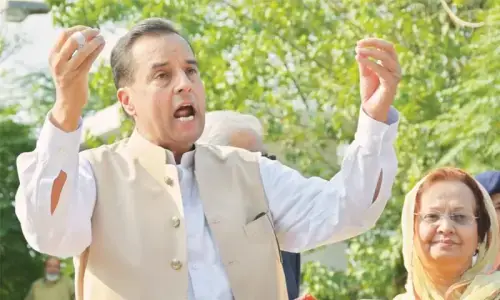
The session, titled Facing the popular will: Election 2024, had veteran politician Afrasiab Khattak, journalist Hamid Mir and caretaker minister for information and broadcasting Murtaza Solangi as panelists while it was moderated by Tamkinet Karim.
To the question whether the election will be held on Feb 8, Khattak said there was uncertainty about it and one should see the elephant in the room. He added the army generals who were ruling the country didn’t want any election or they wanted to prolong the process at least.
Hamid Mir agreed with Khattak, saying the powerful circles wanted to delay the election on the lame excuse of the law and order situation.
“They want ‘somebody’ to be completely disqualified before the election so that he might not get any relief. However, after yesterday’s decision of Qazi Sahib (Chief Justice Qazi Faez Isa), they (powerful circles) would review their earlier opinion and there is less chance now of the election being delayed”. He was referring to the ban on the bat as the election symbol of the PTI.
‘CJ should have stayed from the PTI’s case’; political uncertainty, terrorism, Baloch protest discussed at ThinkFest
Mir predicted that if election would be held on Feb 8, the government would be formed as per the desire of the powers that be and that government would be pushed to enter an agreement like the “Tashkent agreement,” which would be opposed by the masses as well as all political parties, resulting in a movement against the government (and its dissolution).
Solangi said the polls would certainly be held and it had been his consistent opinion since the formation of the caretaker government.
Regarding the SC decision, Khattak said the decision was a political one but it had been given legal cover.
Tamkinet said the election should be free and fair as well. She asked which party had got the level-playing field at the moment while there were also killing fields in the Khyber Pakhtunkhwa and Balochistan. To this, Khattak reminded the audience that only the 1970 general election was fair which was not accepted by the army generals because Sheikh Mujibur Rahman’s party had won it. After that Gen Zia had taken the stance that the election should be held only when positive results would be certain and since then the same policy was being followed.
Regarding the level-playing field, he said no party had it as all the parties were trying to get the vote of the GHQ instead of the masses.
Mir said the SC decision had exposed the party that had got the ‘level-playing field’ and that party whose leadership was in Lahore had got the privilege. He added that for a similar breach of election rules (intra-party election), the ANP was fined just Rs20,000 while it was allowed to run the election on its symbol of Laltain.
Mir said CJ Qazi Faez Isa should have stayed away from the case as a reference was filed against him during the PTI government. He said the PML-N and Justice Isa were on the same page while adding that Faisal Vawda had declared Isa’s verdict one month ago.
When Solangi termed the SC decision “very good”, he was booed by the audience and elicited laughter when he said a legal precedent had been set to force the parties to ensure intra-party election.
Hamid Mir said if the polling turnout went above 50pc or reached 60pc, the results would subvert the plans of the establishment. He said there was resistance in Punjab also now while earlier it was only in Balochistan or Sindh or KP.
Regarding terrorism and law and order situation in Khyber Pakhtunkhwa, Khattak said terrorism was not spontaneous and it was only state agencies tactics of political engineering and they themselves claimed that the Taliban were not a danger but only Pashtun and Baloch nationalists.
“Terrorism is a new way of political engineering. For example, Mohsin Dawar’s car has been attacked because he talks of democracy and national and political rights.”
When asked by Tamkinet
that Maulana Fazlur Rehman’s party was also being attacked by terrorists, Khattak said Fazl’s part was being attacked only in Bajaur because Daesh had its centre in the neighbourhood of Bajaur. “Daesh attacks Fazl because it thinks that he supports the Taliban and Daesh is against them.”
Regarding Balochistan, Khattak said there was a democratic progressive movement in Balochistan but BAP (Balochistan Awami Party) had been formed there. He said Senate was supposed to be the house of federation but it had been turned into ‘the house of conspiracies’. When I was the chairperson of the human rights committee from 2009 to 2015, there were complaints of disappearances and we found out that ISI played a major role in disappearances. The committee decided to make a law in this regard but the agencies decided to control the Senate and the Sanjrani formula was introduced to stop the passage of such laws.
To a question, Hamid Mir said the Baloch women protesters were badly treated and arrested in Islamabad and the government tried to “deport” them from the federal capital like illegal immigrants. However, the local population supported them as against the state institutions. Saying that Baloch women protesters were heart-broken, he added that women in Balochistan were more radicalised compared to their men.
“I don’t see as much hatred among the Bengalis when I go there as I see in Baloch people,” he revealed.
Khattak narrated an incident that he was a part of the commission formed by Justice Athar Minallah to look into grievances of Baloch students. “When we visited the Balochistan University there were few students in the hall to attend the session but surprisingly after sometime thousands of students appeared.” He said a senator from Quetta told him that Baloch girls and boys did not want to attend the Pakistan national anthem at the start of the event. “I saw what I had seen in Dhaka University in 1971,” Khattak said, terming the forced disappearances state terrorism.
Published in Dawn, January 15th, 2024