FROM exchanging missile strikes two weeks ago to trading compliments, Pakistan and Iran have managed to handle a potentially explosive crisis in a mature fashion.
On Jan 16, Iran had bizarrely launched strikes on Panjgur hitting, what it said, were terrorists affiliated with the Jaish al-Adl outfit. Pakistan said two children died in the incident. Two days later, Pakistan replied to the violation of its sovereignty by striking targets in the Iranian town of Saravan neutralising, as per the state, several Baloch separatists.
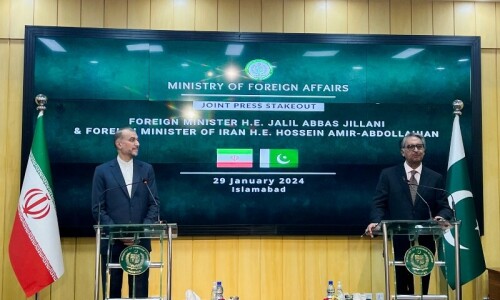
But the acrimony seemed a thing of the past as caretaker Foreign Minister Jalil Abbas Jilani met his Iranian counterpart Hossein Amir-Abdollahian in Islamabad on Monday, indicating that the crisis was now behind both states. It is also hoped that as relations improve, the brutal murder of nine Pakistani workers in Saravan on Saturday is fully probed.
Mr Amir-Abdollahian said both countries were “one nation” while observing that “third countries” were aiding militants in the common border area. Meanwhile, Mr Jilani said that a “high-level mechanism” was being established to oversee bilateral cooperation, while adding that liaison officers would be stationed in Turbat and Zahedan.
Indeed, this display of cooperation is a welcome change from the acrimonious exchanges that had threatened to scuttle bilateral ties. Both sides chose to handle the crisis with wisdom, as opposed to jingoistic nationalism. This should serve as a template to manage all future bilateral ties.
While the exchange of pleasantries makes for good optics, both Islamabad and Tehran need to get down to business and address the single biggest irritant that stands in the way of better ties: border security. Both sides have pledged to work for collective security, and these promises should be followed by action to secure their common border.
Whether it is religiously motivated militants working against Iran that allegedly find refuge in Pakistan, or Baloch separatists plotting against Pakistan on Iranian soil, both sides need to address the threats these non-state actors pose through mutual cooperation; under no circumstances should unilateral action be taken, as Iran did a few weeks ago.
The crisis was defused this time, but there is no guarantee that similar rational behaviour will prevail in the future. With regard to the killing of Pakistani workers, those involved in this heinous crime need to be identified and brought to justice, while Tehran should ensure security for all Pakistanis living in or visiting Iran.
A few weeks from now a new administration will take over in Islamabad, and it will be up to the new rulers to build on the points agreed to during the foreign ministers’ meeting. Both sides should also be wary of inimical foreign actors working to destabilise the border areas in the hopes of souring the Pakistan-Iran relationship.
Published in Dawn, January 30th, 2024