THE cipher case judgement, released on Thursday, offers interesting insights into a case conducted in jail and largely away from public view.
The extraordinary fervour with which this trial had been pursued by the state had been well-established ever since the special court conducting it was rebuked twice by the Islamabad High Court over serious irregularities in the proceedings.
Despite a third chance, however, the court was widely criticised for having fallen well short of what would be considered a clean and fair trial.
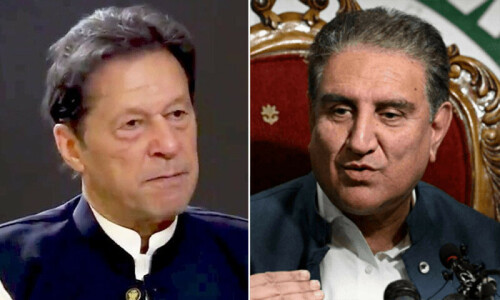
The judgement now makes clear that former prime minister Imran Khan and former foreign minister Shah Mahmood Qureshi were punished not just for their alleged wrongs but also for what the presiding judge described as their “tricky minds” and “tricky acts”.
There is extensive justification in the judgement for why the defendants were denied some of their trial rights — a matter that had caused much controversy when case hearings were abruptly concluded on Monday.
The judgement blames the defendants for trying to prolong the proceedings and claims they refused to defend themselves. The judge reasons they did so in order to weaken the court’s verdict so it would be struck down in appeal.
In doing so, the entire burden of the irregularities reported in the conduct of the case seems to have been shifted onto the defendants. Importantly, the biggest ‘crime’ the two have been punished for seems insufficiently substantiated.
The court finds the two guilty of “compromising the security of the state and the communications methods used by Pakistan’s foreign missions”. However, the Foreign Office has affirmed this week that its communication systems have been audited and are safe and protected. If so, what exactly are the two guilty of?
Furthermore, the question of whether it is the prime minister’s prerogative to make public any privileged information has not been addressed. Instead, the perceived harm to Pakistan’s relations with the US and foreign lenders due to the decision to go public with the cipher’s contents seems to have been given much more precedence than the fact that this decision was made by Pakistan’s chief executive at the time.
There is no doubt that Mr Khan and Mr Qureshi massively overstepped by deciding to use a diplomatic matter as a political shield. The fact that Mr Khan misplaced his copy of the cipher is also a grave concern.
However, neither of these, on its own, seems like reason enough to justify punishing two senior decision-makers so harshly. Pakistan’s weak international standing is a result of years of bad policies and irresponsible actions.
Without a doubt, the cipher stunt worsened Pakistan’s ties with a major trading partner and global power. However, it is not the sole reason for our soured diplomatic ties with the US.
Published in Dawn, February 3rd, 2024