Economist Atif Mian urges next government to outline priorities


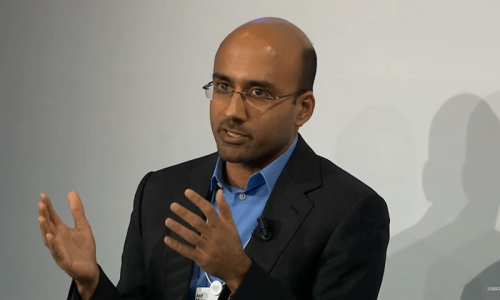
WASHINGTON: Atif Mian, a prominent Pakistani-American economist and Princeton University professor, has urged the nation’s future leaders to brace themselves for a challenging economic journey and to outline priorities for recovery.
Mian emphasised the country’s consistent global economic decline, highlighting last year’s contraction and alarming macroeconomic indicators such as inflation, stunted growth, escalating debt, and diminishing investment.
“The federal government has reached a critical point where it lacks the financial means to sustain basic operations, unable to pay the salaries of even low-ranking employees without resorting to borrowing,” Mian remarked.
He pointed out that the entire tax revenue is exhausted after disbursing shares to provinces, settling pensions for retirees, and servicing the burgeoning debt, leaving the government running on a perpetual deficit. He asserted that the dire economic situation exacerbates inflation, making it uncontrollable within a deficit-driven governance structure.
Mian also argued that growth becomes an unattainable goal when the government is unable to invest in the future due to financial constraints. “The country is bankrupt, sinking deeper every year. I have never seen such despondency. So many wanting to leave, established firms no longer comfortable investing,” said Mian, emphasising the gravity of the situation.
Addressing the Feb 8 elections, Mian highlighted the people’s frustration, stating, “People are mad — and they have every right to be.”
He underscored the staggering human cost of poverty, citing the alarming statistic of 442,353 children dying in Pakistan last year due to impoverished conditions. Mian criticised the establishment for playing “usual games,” manipulating the political landscape without addressing the pressing economic challenges.
In the aftermath of the elections, Mian observed a widening gap between the ruling elite and the general populace, emphasising the potential dangers associated with such a disconnect. He noted the establishment’s attempts to form a compromised government but questioned its effectiveness, stating, “No one has a plan to fix the economy, but even if they magically did somehow, they cannot do anything because they have lost all trust with their people. They are foreigners in their own land.”
On Monday, the Atlantic Council convened a virtual conversation in Washington where experts delved into the intricate implications of Pakistan’s political economy in the aftermath of the Feb 8 elections.
Safiya Ghori-Ahmad from McLarty Associates underlined Pakistan’s concern about being recognised as credible by the US.
“Pakistan does not want to be a part of the countries not recognised as credible by the US,” she said. She was also critical of another government initiative, the Special Investment Facilitation Council (SIFC), as it was still not clear how that would work.
She highlighted the significance of the next few weeks in observing the country’s transformation, particularly in its relations with the IMF and efforts to address inflation.
Ammar H. Khan, a nonresident senior fellow at the Council’s South Asia Centre, outlined the top priority for the next 100 days — addressing the energy crisis.
Published in Dawn, February 13th, 2024