ISLAMABAD: The caretaker government is likely to make a fresh attempt to promulgate an ordinance amending the Indus River System Authority (Irsa) Act, 1992, aiming to limit irrigation-related operational decision-making powers of the inter-provincial water regulator and enhance the financial autonomy of its non-member chairman to impose charges, fees, or cess for hiring experts and consultants.
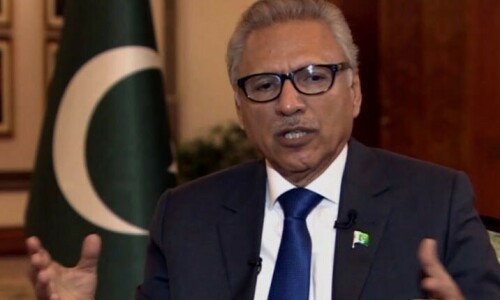
Sources said that earlier this month, President Arif Alvi rejected a draft Irsa Amendment Act, citing concerns that such a critical matter involving the interests and rights of the federating units should not be considered hastily by an unrepresentative administration.
However, sources said that the incumbent setup want to ensure changes to the water regulations before the elected government assumes office who might delay the changes and wait for an appropriate opportunity.
According to the draft ordinance, the restructured Irsa would gain powers through a new clause in the Irsa Act to “impose, vary, and recover fees, charges, cess, or other sums, from time to time, as may be prescribed”. This would strengthen the new chairman, on top of the existing five-member body, in terms of financial autonomy.
Make fresh attempt to propose amendments in authority’s act after president rejected previous draft
The explanation to the clause says that the cess levied and collected “may be utilised for the purposes of, or in relation to, the integration and maintenance of telemetry system, upgradation of existing water-related infrastructure, or development of modern water regulation and monitoring systems or human resource development and capacity building thereof”.
The proposed amendments would apparently curtail the collective inter-provincial decision-making powers on irrigation and other operational matters and deprive the provinces of holding the position of Irsa chairman.
Currently, the post is held on an annual rotational basis by five members representing the provinces and the centre.
Instead, the post is proposed to be always filled directly by the prime minister, rather than federal government. The chairman would have overwhelming powers through his handpicked committee of “independent consultants and experts” in critical decision-making relating to the irrigation system.
The chairman will possess the authority to appoint a convener of the “Independent Experts Committee” (IEC) to act as the chairman of the IEC. The Irsa chairman will also appoint two experts in hydrology, hydraulic modelling, or related engineering, two experts in remote sensing, GIS, irrigation, or related engineering, and four experts in other related fields. The IEC, based on the chairman’s recommendation, may also co-opt other experts.
The IEC will also advise on monitoring, handling, compilation of telemetry data, determine gains and losses in water distribution during two cropping seasons, maintain water accounts, and render technical advice to the chairman. Interestingly, all these matters fall within the jurisdiction of Council of Common Interests, which some cabinet members and the president had advised to be left to the new political dispensation.
The draft law sought to restrict provincial governments from approaching the CCI when aggrieved by any decision of the Irsa. Instead, it requires the review to be filed before the Irsa chairman, who would decide the matter through speaking orders after consulting with the IEC.
On top of this, such a decision of the chairman (a grade-21 officer) “shall be final and shall not be called into question before any court, forum or authority, except the CCI”.
The chairman alone will have the powers to request the federal government to provide adequate security “through the Armed Forces of Pakistan or other law enforcement agencies” for protection of any location or installation.
To downgrade provincial representation, the proposed ordinance suggested the creation of the post of vice chairman Irsa, to be filled on rotation basis from amongst the members.
To sidestep the Supreme Court judgement, which defines the federal government as the cabinet instead of the minister or the prime minister, the draft law replaced the words “federal government” explicitly with the “prime minister” to avoid collective decision-making in such appointments.
Published in Dawn, February 19th, 2024