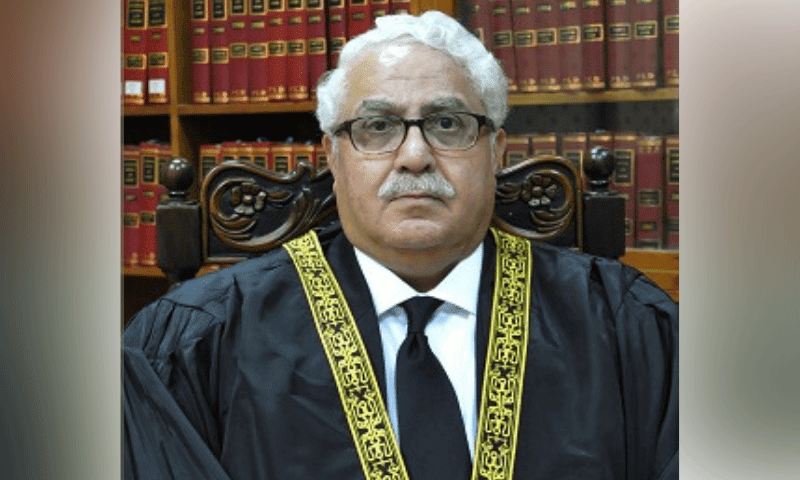
The Supreme Court (SC) on Wednesday ruled that the resignation or retirement of an apex court judge would not dispose of Supreme Judicial Council (SJC) proceedings already under way against them.
A five-member bench delivered a four-to-one majority decision during a hearing on the federal government’s intra-court appeal against the apex court’s 2023 verdict in the Afiya Shehrbano Zia case, which had held that judges who either retire or resign cannot be questioned by the SJC over alleged misconduct.
The bench was headed by Justice Aminuddin Khan and included Justices Jamal Khan Mandokhel, Musarrat Hilali and Irfan Saadat Khan while Justice Syed Hasan Azhar Rizvi dissented from the majority decision.
The court ruled that only the SJC would have the authority to terminate the proceedings against a judge in case of their retirement or resignation.
Last month, former SC judge Sayyed Mazahar Ali Akbar Naqvi — who was facing complaints of misconduct — resigned from the apex court, however, the SJC had decided to continue the hearing of complaints against the judge despite his resignation.
The federal government had also subsequently appealed the decision in the Afiya Shehrbano Zia case which was accepted by the apex court.
The federal government had pleaded that the 2023 verdict, issued by a two-judge bench, including the now-retired Justice Ijazul Ahsan and Justice Munib Akhtar, made the SJC “virtually redundant” by making Article 209 inapplicable to judges who either retire or resign.
On Feb 12, the five-judge bench hearing the appeal had appointed former attorney general Khalid Jawed Khan, senior counsel Khawaja Muhammad Haris, Abdul Moiz Jaferii, and Faisal Siddiqui as amici.
The bench had sought assistance in determining whether pending proceedings before SJC were abated if the judge retires or resigns.
The court had also asked if the judge’s resignation — at a time when the SJC is hearing complaints against them — was tantamount to avoiding accountability under Article 209 of the Constitution.
Attorney general’s arguments
Attorney General for Pakistan (AGP) Mansoor Usman Awan told the court that it was the SJC’s authority to prosecute misconduct committed while serving as a judge.
He said that the judiciary played the role of mediator between the people and the government, adding that the judiciary guaranteed fundamental rights and therefore should be independent.
“For independence of the judiciary, accountability of judges is necessary,” he said. He said the objection to the accountability of judges would harm the independence of the judiciary.
He added that the SJC should be self-motivated towards the independence of the judiciary, clarifying that only the SJC had the power to carry out inquiries against judges under Article 209 of the Constitution.
Awan said that it was not necessary to recommend a judge’s dismissal if they violated the code of conduct.
“If a judge is suffering from mental illness, it is possible to treat him. Based on the treatable diseases, the council can give a judge a temporary leave, not necessarily dismiss him. If there is a complaint against a judge for not keeping time, the council can issue a warning instead of dismissal,” he said, adding that if a complaint came before the council, it was necessary to give an opinion on it.
While speaking about their retirement, Awan said that judges were appointed to constitutional positions after they retired and that the council must give its opinion on the charge against the judge for them to be appointed.
“Judges should be held accountable, but this accountability should not reduce the prestige of the Supreme Court,” Awan continued.
“No other institution can take action against the judges,” he said.
Awan said that charges could only be brought against a judge during their service and for the people to trust the courts, the SJC should work transparently.