• Refusals more common in posh areas of metropolis
• Vaccine hesitancy identified as a significant barrier to immunisation coverage
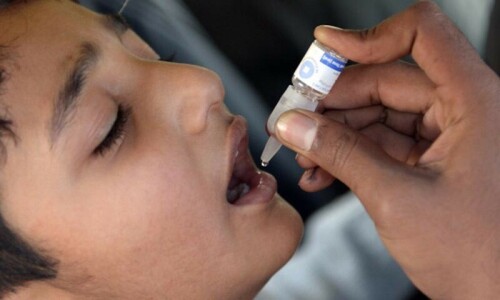
KARACHI: Highlighting Pakistan’s polio-related challenges, experts at a session held on Thursday identified vaccine hesitancy as a significant barrier to the immunisation coverage, particularly in Karachi, a city with the highest refusal rate for polio vaccination in the country.
The problem, it was pointed out, had more to do with people’s attitudes than literacy levels.
The experts were speaking at an orientation session organised by Emergency Operations Centre for Sindh (EoC) for journalists at a local hotel.
“Surprisingly, refusal is more common in posh areas in Karachi, representing well-off, educated families. In fact, people with lower levels of education show more understanding towards polio vaccination,” Dr Khalid Shafi representing the Pakistan Paediatric Association said, adding that there were many people who were simply dismissively stubborn and refused to listen to logic.
He, however, credited the government for “effectively controlling the disabling and life-threatening disease” and said polio was 100 per cent controlled in Karachi for two years.
“The virus came from outside (and spread in the city),” he said, while explaining that last year Pakistan had come very close to polio eradication.
“Only two clusters were left in Khyber Pakhtunkhaw. Unfortunately, the opportunity was lost on account of poor law and order situation in the (high risk) areas bordering Pakistan and Afghanistan as people moved from vulnerable areas to other parts of the country.
Dr Shafi, also part of the WHO team and national programme on polio, called for more focus on routine immunisation and containing people’s movement from high-risk parts of the country.
“It’s important that every child gets 12 to 13 doses of polio vaccine for effective protection against the illness. Children, who have already received few doses during their routine immunisation, should also be allowed to get more doses offered in the government-launched campaigns.”
Earlier, Dr Shaukat Ali, representing the Unicef, spoke about the challenges and the progress made against the illness in the country.
The poliovirus, he said, was now endemic only in Afghanistan and Pakistan and that interrupting the virus transmission in this epidemiological block was critical to reaching zero polio.
In reply to a question, he said that the total population of missed children in Sindh stood around 5,000.
“This number has constantly been on the decline as we continue to improve our strategy for better outcomes,” he said.
The data shared in the programme showed that while the number of cases remained in the single digits in Pakistan in 2023, 126 environmental samples tested positive for the virus – a more than threefold increase from 2022.
Nearly 96pc of these samples contained the imported virus cluster of YB3A, which had not been seen in the country since 2021 and was reintroduced in 2023.
This increased detection of environmental samples, the experts said, could be explained by excessive population movement and the expansion of the environmental sample network throughout 2022 and 2023.
However, the volume of these detections also highlighted the continued risk of cross-border transmission and the need for both countries to work on joint efforts to control the spread of the virus.
The indigenous YB3C cluster, which was the dominant virus throughout 2022 in Pakistan, remained restricted to the seven endemic districts in southern Khyber Pakhtunkhwa, where it was detected in five environmental samples and three children in 2023.
“The Wild Poliovirus Type 1 was found in 30 sewage samples in 19 districts in January with new detections in Kech, Nasirabad, Sibi and DG Khan, which have largely remained negative in previous years,” Dr Ali said.
All affected districts were covered during the nationwide vaccination campaign in January, which was considered the first round of outbreak response, while the next campaign is scheduled for February 26 and would be the second nationwide campaign of the year, he added.
Published in Dawn, February 23rd, 2024