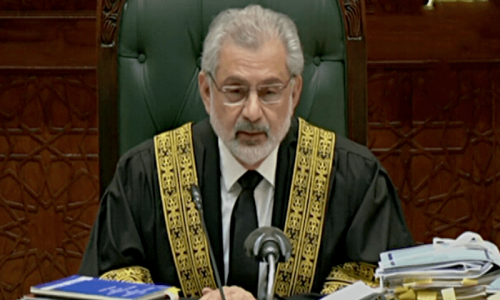
ISLAMABAD: The Supreme Court on Monday ruled that the Lahore High Court, while declaring unconstitutional the special court’s order of awarding death sentence to former military ruler Gen Pervez Musharraf on Jan 13, 2020, not only assumed the exclusive jurisdiction of the trial court, but also usurped the appellate jurisdiction of the apex court.
“The high court should have remained within the confines of the dispute brought before it and decided the same in accordance with the law and the Constitution,” observed Justice Syed Mansoor Ali Shah in a judgement he wrote.
Justice Shah was a member of the four-judge SC bench which had on Jan 10 this year upheld the death sentence awarded by the special court to former president retired Gen Musharraf in 2019 for high treason.
In its decision, a three-judge LHC bench headed by Justice Sayyed Mazahar Ali Akbar Naqvi, who resigned as the Supreme Court judge, had held that the trial of Gen Musharraf in absentia was illegal, unconstitutional, and repugnant to injunctions of Islam, as well as Articles 2A, 8 and 10-A of the Constitution.
High court declared special court’s order of awarding death sentence to ex-president unconstitutional
Now in the detailed judgement, Justice Mansoor Ali Shah explained that the LHC not only assumed the jurisdiction not vested in it, but also dilated upon the merits of the matter, which it could not do as the high court was not an appellate forum.
The high court, without enjoying any jurisdiction whatsoever, gave its own findings on the core subject matter of the trial, i.e. whether the respondent had committed the offence of high treason under Article 6 of the Constitution.
By doing so, the LHC unlawfully assumed the appellate jurisdiction exclusively vested in the Supreme Court, Justice Shah regretted, adding that the high court also granted relief which was not even sought in the writ petition.
The relief sought in the prayer clause of the writ petition mainly challenged the order of the special court, but no prayer was made to seek a determination whether Gen Musharraf had committed high treason, the judgement said. Yet the high court overstretched its jurisdiction by proceeding to determine the core question and then held the actions of Gen Musharraf were not part of Article 6 at the time of the commission of the offence.
The verdict said the high court also declared the entire Section 9 of the Special Court Act as ultra vires of the Constitution, even though the respondent had only challenged its ‘offending portion’ to the extent it provides that “no trial shall be adjourned by reason of the absence of any accused person due to illness”.
“A plain reading of Section 9 shows that it deals with the absence of the accused person not only due to his illness but also where the absence of the accused person or his counsel has been brought about by the accused person himself, or where the behaviour of the accused person prior to such absence has been such as to impede the course of justice.
In such cases, the special court is mandated to proceed with the trial after taking the necessary steps to appoint an advocate to defend such an accused person,“ the judgement said.
It added that the high court had failed to adhere to earlier judgements and orders of the Supreme Court and thus undermined the credibility and effectiveness of the entire judicial system established by the Constitution.
The judgements of the Supreme Court being binding on all judicial and executive authorities of the country is a constitutional obligation.
This obligation reflects a fundamental commitment to preserving the integrity and sanctity of the Supreme Court.
Disregard of the previous judgements and orders by the Lahore High Court amounts to judicial effrontery and impropriety.
The impugned judgement passed by the Lahore High Court in sheer violation of the judgements and orders of this Court,“ the verdict said.
Justice Shah emphasised that the decisions by the courts must be guided by the law, precedents and the facts before them and not by personal desires or objectives.
Published in Dawn, March 5th, 2024