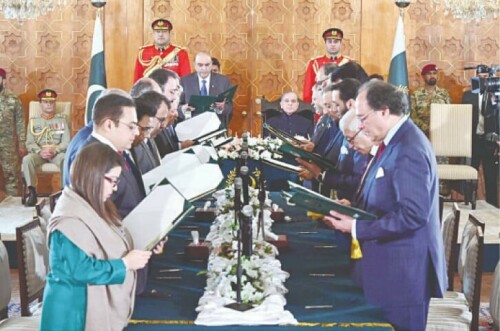
ON Tuesday, at his first formal interaction with reporters after assuming control of Q Block, Finance Minister Muhammad Aurangzeb dropped some clear hints about the kind of financial policies he intends to pursue, at least in the short to medium term.
Signalling the continuation of IMF-mandated stabilisation policies under the $3bn Stand-by Arrangement, the former banker said that Pakistan, a sovereign, nuclear state, could no longer afford to continue with a ‘patchwork’ approach to deep-rooted economic woes if it wanted to address the challenge posed by low economic growth and inflation.
He was also clear about the Sharif government’s plan to kick-start discussions for a new, larger and longer IMF loan during the international lender’s visit for the second and final review of the current nine-month facility that ends soon.
“We would at least kick-start the process and get this going. Let us see how they respond,” he said. Further negotiations on the fresh programme would be taken forward on the sidelines of the spring meetings of the IMF and World Bank in April in Washington, it was mentioned.
The finance minister’s message was unmistakable: the government is aiming for permanent macroeconomic stabilisation even if it comes at the cost of growth. He said that the country should not expect cash deposits and debt rollovers from friendly countries, and that it was necessary to achieve the structural benchmarks laid out in IMF programmes signed by Pakistan’s previous finance ministers, as turning to patchwork measures was no solution. Inflation, he stressed, could only be addressed by achieving macroeconomic stability.
Faced with a daunting challenge, the minister’s prescription for the interlinked issues of low growth, balance-of-payment troubles, inflation and fiscal deficit afflicting the economy indicate a plan for a consequential overhaul of the government as well as its budget over the next several years. His plan also represents a significant departure from the PML-N’s signature economic and financial policies.
The question is: will he get enough room to execute the stabilisation policies for as long as it is required? What is the guarantee that the ruling party will support his attempts to effectively tax its core political constituency of retailers or the powerful real estate mafia? Last but not the least, how long will the government resist the temptation of spurring growth without executing the long-standing structural reforms once forex reserves rise to a comfortable level, as it panders to its vote bank?
Indeed, the new army-backed SIFC created last year to attract investment from the Gulf nations is widely expected to help him. Still, the success of the finance minister’s stabilisation agenda will hinge largely on his ability to manage the desires and demands of the party in power, without digressing from the path of reform.
Published in Dawn, March 14th, 2024