Macroeconomic stability unachievable without another IMF programme: PM Shehbaz


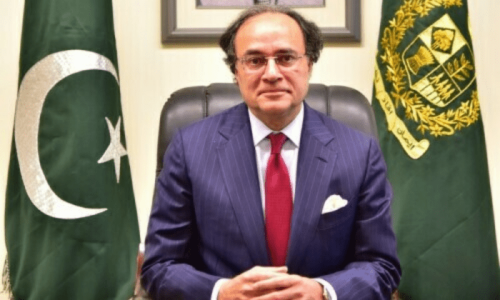
Prime Minister Shehbaz Sharif on Thursday said that macroeconomic stability in the country needed to be advanced further, which he said would not be possible without another bailout programme with the International Monetary Fund (IMF).
A day ago, while announcing the staff-level agreement (SLA) on the successful completion of an existing short-term facility, the IMF had confirmed that Pakistan was seeking a 24th medium-term bailout package for a permanent push towards longstanding structural reforms.
In its end-of-mission statement, the IMF had said that subject to the approval of its executive board, the staff-level agreement would enable Pakistan to access about $1.1 billion — 828 million special drawing rights (SDR) — by late April.
While addressing a meeting of the Special Investment and Facilitation Council’s (SIFC) Apex committee today, PM Shehbaz congratulated the finance ministry for closing the SLA with the IMF, and expressed hope that the $1.1bn tranche would arrive next month.
“[However], is this our ultimate achievement? The answer is a big no. We have to bring economic stability at the macro-level and we have to progress it for which it is decided that we cannot survive without another [IMF] agreement.”
The prime minister questioned whether another programme would be able to bring economic stability, increase the growth trajectory and bring prosperity.
He stressed that the newly elected government would have to work towards a medium-term programme which would have the duration of two-to-three years. “And during those years, the government will have to undertake deep rooted structural reforms,” the premier added.
He further said: “To think that the economy will stop bleeding without undertaking those steps is a dream.”
PM Shehbaz gave the example of the Federal Board of Revenue (FBR), citing the need to reform and digitise the institution.
The prime minister also credited the political parties for their role in the successful negotiations with the IMF.
“When Pakistan came to close to being a brink of bankruptcy, the political parties set aside their differences to work for the country,” he said, adding that the reforms taken up the the interim government helped achieve the successful IMF reviews.
He also expressed his gratitude toward the SIFC, stating that it had helped overcome bureaucratic hurdles without going into details.
The prime minister ended the meeting on emphasising the importance of political parties setting aside their differences to work towards the wellbeing of the country, highlighting that politics should be secondary to the state’s interests.
A press release from the Prime Minister’s Office said the army chief reassured the military’s “fullest support to backstop the economic initiatives of the government” and to ensure the provision of a safe, secure and conducive environment to nurture the country’s true economic potential.
It added that PM Shehbaz urged the federal cabinet to “join hands, keep political differences aside and work as a cohesive team” to keep the momentum of economic stability.
The combined leadership also vowed to ensure the continuation of policies and take tough decisions in the country’s larger interest by setting correct economic priorities.
Next IMF programme
The Fund’s statement had said Pakistan that “expressed interest in a successor medium-term Fund-supported programme with the aim of permanently resolving Pakistan’s fiscal and external sustainability weaknesses, strengthening its economic recovery, and laying the foundations for strong, sustainable, and inclusive growth”.
It said the IMF team reached a SLA with the Pakistani authorities on the second and final review of Pakistan’s stabilisation programme supported by the IMF’s $3 billion standby arrangement approved in July last year.
While doing so, the Fund also laid bare the broader, though well-known, conditionalities of the next programme on which “discussions are expected to start in the coming months”, the statement had added.
As in the past programmes, four central areas would remain under focus for reforms. The top objective of the next medium-term programme — Extended Fund Facility of about 36 to 39 months — would be strengthening public finances, including through gradual fiscal consolidation and broadening the tax base, especially in under-taxed sectors (read real estate, retail and wholesale trade and agriculture) and improving tax administration to improve debt sustainability and create space for higher priority development and social assistance spending to protect the vulnerable.
The second objective of the next programme would be restoring the energy sector’s viability by accelerating cost-reducing reforms, including through improving electricity transmission and distribution, moving captive power demand to the electricity grid, strengthening distribution company governance and management, and undertaking effective anti-theft efforts.
The third key objective would be returning inflation to the target, with a deeper and more transparent flexible foreign exchange market supporting external rebalancing and rebuilding foreign exchange reserves.
The fourth and last critical aim would be promoting private-led activity through the above-mentioned actions as well as the removal of distortionary protection, advancement of reforms on state-owned enterprises to improve the sector’s performance, and the scaling up investment in human capital to make economic growth more resilient and inclusive and enable Pakistan to reach its economic potential.