ISLAMABAD: Just before the end of its tenure, the caretaker government allowed a cost escalation of about 30pc to “ongoing contracts” of hundreds of development projects, financed under the Public Sector Development Programme (PSDP) of the federal government.
The country’s large development portfolio has always been subject to time and cost overruns, leading to repeated revisions in financial costs, besides loss of opportunity costs.
According to the International Monetary Fund (IMF) estimates for the fiscal year 2022-23, the federal PSDP portfolio of Rs10.32 trillion alone contained about 1,153 development projects. This includes 909 ongoing projects worth Rs7.96tr, coupled with the addition of 244 new projects with a total cost estimate of Rs2.26tr.
Against such a large programme, the 2022-23 budget allocated a paltry sum of Rs727.5bn. It is no wonder the IMF believed that this rate of execution required, on average, 14.1 years for a project to reach completion, and that too only if no new projects were started during this time.
Inflation, slow pace of work, exodus of contractors cited as reasons behind decision; applicable only to projects signed before Sept 2022
Such a consideration is beyond imagination, considering the country’s growing population and politicians’ tendency to win support mostly through government-financed development schemes.
These estimates also do not include provincial programmes, which are generally more than double the size of the federal scheme and follow federal precedents for revisions in rates.
Ecnec cost revision
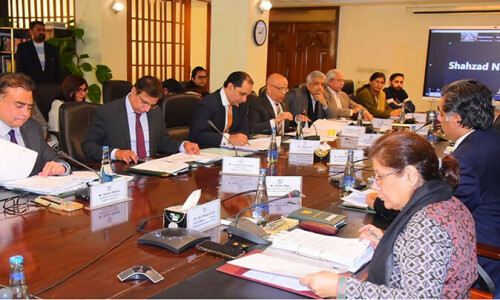
Informed sources said the increase in the cost of escalation for contracts of ongoing projects was allowed a day before the February 8 polls by the Executive Committee of the National Economic Council (Ecnec), led by then caretaker finance minister Dr Shamshad Akhtar. The increase came on the premise of inflationary pressures, particularly a rise in the cost of construction materials.
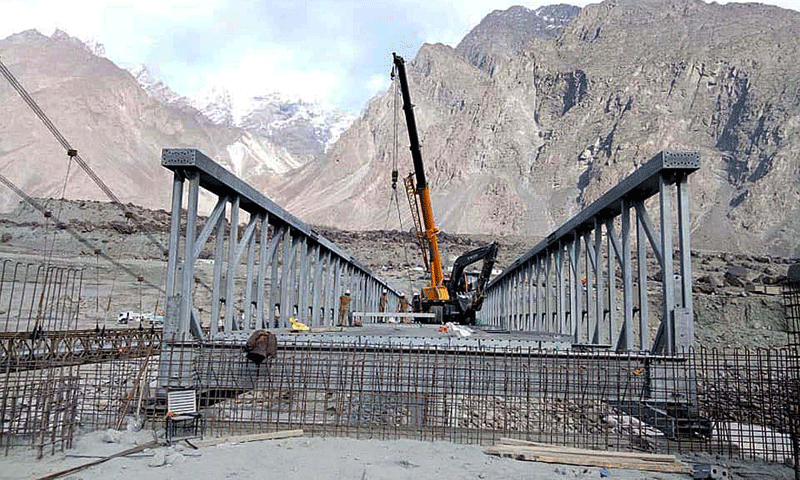
It was argued that many contractors had stopped work on mega infrastructure projects because of cost overruns, while others had slowed down and some had even given up their contracts.
“The executive committee of the Ecnec considered the summary dated February 7, 2024, submitted by the Ministry of Planning, Development and Special Initiatives, titled ‘Criteria and Procedure for Incorporation of Price Adjustment provisions in the on-going contracts, August 2022 (Amended June 2023-Modified Jan 2024)’ and approved the proposal,” say the minutes of the Ecnec meeting.
Under the decision, “fixed vs adjustable cost ratio” at 30:70pc and “minimum weightage of adjustable cost elements revised from nil to 3pc”. This cost escalation would generally be applicable to “projects whose contracts had been signed before September 2022” and the price adjustment is now allowed to “part of works executed after January 1, 2021”.
Therefore, the revised document of ‘Standard Procedure and Formula Price Adjustment — amended June 2023’ will not be applicable on contracts signed after September 30, 2022, an order issued by the planning commission clarified following the Ecnec decision.
It explained that differences in price calculation will be processed through concerned forums such as the Central Development Working Party, Departmental Development Working Party, or the Ecnec.
The commission has also asked the science and technology ministry and the Pakistan Engineering Council to revise their technical codes and process all development projects based on revised rates.
IMF irked by PSDP approach
The IMF, in a recent technical assessment, criticised Pakistan’s development approach and its weak execution, saying it was not possible to easily identify how the cost of major projects changed over time.
“In recent years, significant under-execution of the PSDP has put the realism of both PSDP budgets and multi-year projections into question. This is systematic across federal and provincial governments,” it said.
At the federal level, a little over half of the PDSP was spent on economic infrastructure (energy, transport, water etc) and the remaining was spent on social infrastructure (education, health etc.).
The PSDP reports the total cost for projects benefiting from federal or external funds. There is, however, no annual breakdown of this cost over the medium term, the IMF noted. It said the current arrangements do not enable line ministries to plan the delivery of a realistic multi-year capital programme, it said.
Insufficient information on the evolution of the total cost of major projects could explain instances when large cost overruns have only been identified ex-post in the past. The auditor general of Pakistan (AGP) has identified several such instances in performance audits of projects. A recent example is the Golen Gol Hydropower Project, which showed a final cost of Rs30bn for a project initially estimated at Rs7bn.
Published in Dawn, March 25th, 2024